When you’ve been teaching for a long time, you sometimes have to retire your best material.
Not because it isn’t good anymore.
Because your students have no idea what you’re talking about.
When I was a child, we looked forward to the once-a-year broadcast of the 1939 movie The Wizard of Oz, starring Judy Garland. It was such an event that my parents actually allowed us to stay home from church on the Sunday evening when it aired.
We had no other way to watch it.
That seems almost unbelievable now, but if something wasn’t being shown on one of our three national television networks or two local channels, we simply didn’t see it. There was no streaming. No DVR. No pausing. No watching it tomorrow.
And commercials were important. That’s when you went to the bathroom or ran to the kitchen for a snack.
Because of this, people in my generation KNOW The Wizard of Oz.
And so do many of our children—because we insisted that they know it too.
The Perfect Example
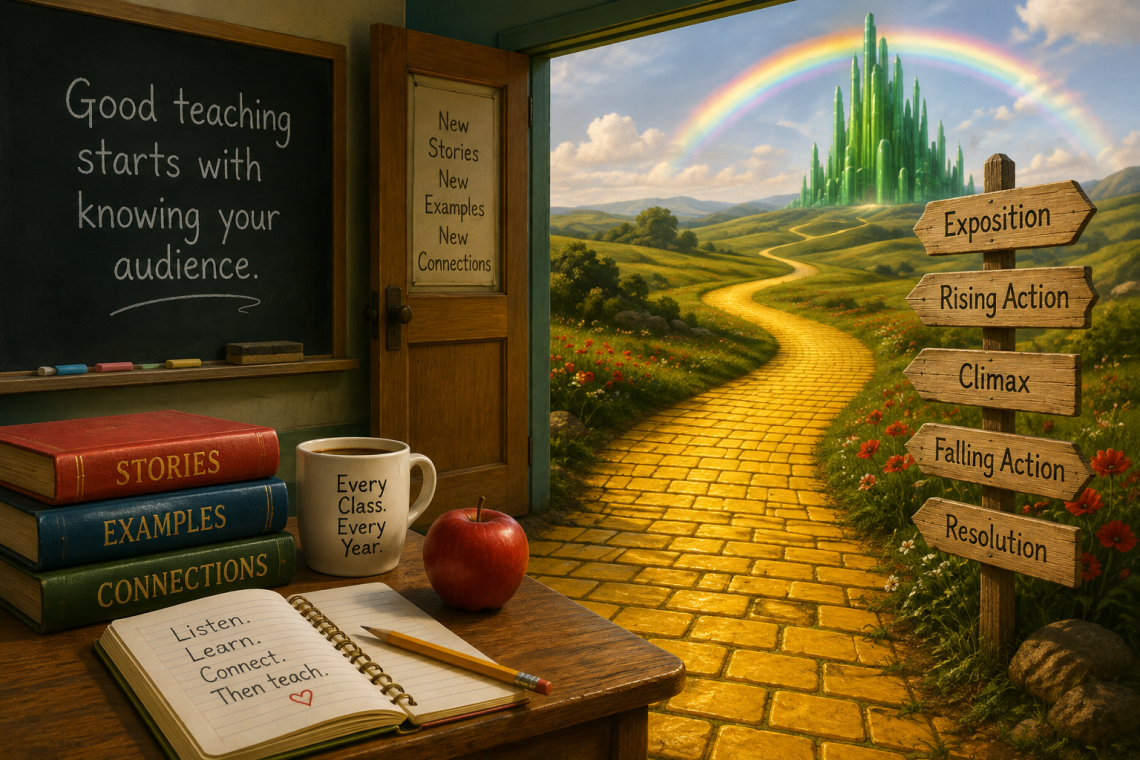
When I started teaching English, I discovered that The Wizard of Oz was the perfect way to teach the basic plot structure of fiction.
Exposition
The black-and-white opening.
We meet Dorothy, Aunt Em, Uncle Henry, the farmhands, Miss Gulch, and Toto. We learn the setting, meet the villain, and discover what Dorothy wants.
She wants to go somewhere over the rainbow.
Rising Action
Then Dorothy opens the door of the farmhouse.
Color.
Suddenly, everything has changed—including what Dorothy wants.
Forget somewhere over the rainbow. Now she just wants to go home.
So she follows the Yellow Brick Road to the Wizard, gathering the Scarecrow, Tin Man, and Cowardly Lion along the way. With each encounter with the Wicked Witch of the West, the conflict builds.
Climax
Dorothy throws the water.
The Wicked Witch melts.
It’s the turning point. The villain is gone.
But Dorothy’s problem isn’t solved.
She still wants to go home.
Falling Action
Dorothy and her friends discover that the great and powerful Wizard is a humbug.
And eventually Dorothy learns something even more important: she has possessed the power to go home all along.
Resolution
Black and white again.
Dorothy awakens from her concussed dream, surrounded by the people she loves, overwhelmed with gratitude to be home.
And she announces that if she ever goes looking for her heart’s desire again, she won’t look any farther than her own backyard.
It was perfect.
Seriously. The entire plot diagram, wrapped up neatly in one movie nearly everyone knew.
Until they didn’t.
As the years went by, fewer and fewer of my students had seen The Wizard of Oz.
At first, I couldn’t believe it.
You’ve never seen The Wizard of Oz?
Eventually I realized I had a problem.
It’s not a Perfect Example anymore
An example only helps explain a complex idea when the example itself doesn’t require an explanation.
If I have to spend ten minutes explaining Dorothy, Toto, the Wicked Witch, the Yellow Brick Road, and why the movie suddenly changes from black and white to color before I can explain plot structure, my “simple example” isn’t simple anymore.
Once, I decided to solve the problem by showing them the movie.
Once.
It. Took. For-e-ver.
And somewhere along the way, I learned an important lesson about teaching.
The common example has to be common to the experience of your students—not yours.
The examples that worked beautifully ten years ago may not work today. The movie everybody had seen may become the movie nobody has seen. The song everybody knew becomes ancient music. The celebrity everybody recognized becomes, “Who’s that?” The technology that once needed no explanation becomes something in a museum.
Good teaching requires us to keep learning our students’ world.
Listen to what they’re talking about. Find out what they’re watching. Learn the stories they know, the references they understand, and the experiences they share. I understand. Add “keeping up with teenage pop culture” to the ever-growing list of teacher responsibilities no one mentioned in the job description.
Then use those things to build the bridge to what you want them to learn.
Because it doesn’t matter how perfect your example is if your students don’t understand the example.
So, veteran teachers, occasionally take a hard look at those tried-and-true examples you’ve been using for years.
Some of them may still be wonderful.
And some of them may need to follow the Yellow Brick Road into retirement.
No matter how painful it may be.