When I taught AP Language and Composition, literary nonfiction was the backbone of my course. I read a lot of memoirs because I taught them, but they were also among my favorite books to read for fun. Give me a mystery, crime drama, biography, or memoir, and I’m happy.
Romance? Never. Ugh.
So when I stumbled across Ken Dornstein’s The Boy Who Fell Out of the Sky, I was immediately intrigued. I remembered the bombing of Pan Am Flight 103 over Lockerbie, Scotland, in 1988, and I was fascinated by the premise of the book.
Dornstein’s older brother, David, was one of the 270 people killed in the bombing. He was only twenty-five. Years later, Ken began trying to understand the brother he had lost. David had left behind notebooks, journals, letters, unfinished manuscripts, and other fragments of his life. Ken gathered those pieces, talked with people who had known David, traveled to places that had mattered to him, and began piecing together the story of who his brother had been.
In a sense, he was putting his brother back together.
After all these years, one passage from the book has stayed with me.
Ken includes a journal entry David wrote on December 13, 1983—five years before he would die aboard Pan Am Flight 103. David was thinking about memory and identity and about his desire not to disappear with time. Then he played with the word itself:
“To be re-membered! Put back together from scattered parts.”
He continues the image with organs and limbs being gathered together and a desire “to hold together over time.”¹
Now, before my fellow English teachers come after me, I know that’s not actually the etymology of the word remember.
But what an image.
Before something can be re-membered, at least in this word-picture sense, it must first have been dis-membered.
Scattered.
Separated.
Pieces that once belonged together, scattered apart.
Gathering the Pieces
Isn’t there something about human memory that really does work that way?
Think about what happens around a table after a funeral.
One person tells a story.
Someone else remembers something completely different.
Do you remember when she…?
I’ll never forget the time he….
There is laughter over a story someone hasn’t heard in years. Someone adds a detail everyone else had forgotten. Someone tells a story that begins, I don’t think I’ve ever told you this….
Each person brings a piece.
And gradually those individual memories come together almost like patches in a quilt, giving us a fuller picture of the person we loved.
We re-member them.
Maybe that’s one reason those conversations are so precious. We aren’t simply reminiscing. We’re gathering pieces that have been scattered among different people and different times and bringing them back together.
For a little while, around that table, the person seems somehow nearer.
The Things We Keep
I have boxes of things that belonged to a great-aunt and great-uncle of mine.
Individually, they’re just objects. But they’re not just objects to me. Each holds a little piece of a story.
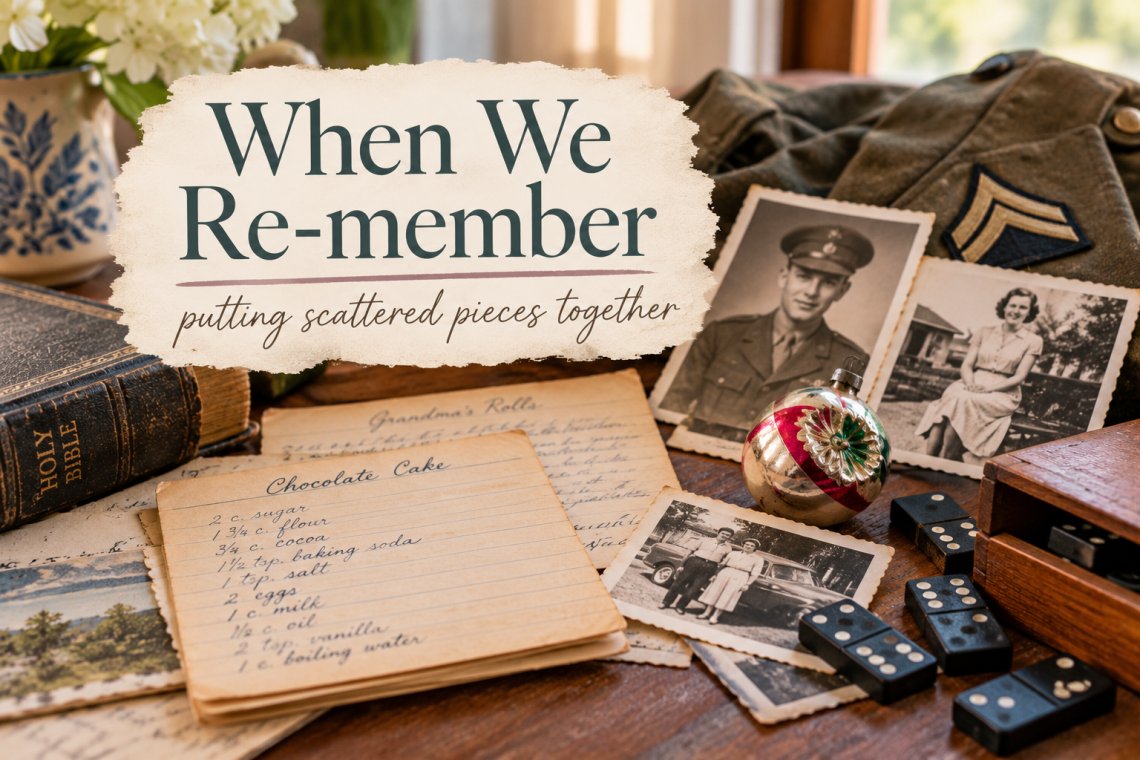
My uncle’s WWII uniform. My aunt’s recipes in her handwriting. Her dominoes that my grandchildren now enjoy. The stool from their pump organ that is now part of my bathroom “maintenance station.”
Taken separately, they’re fragments.
But put them together and something of the people who owned them comes back into view.
I re-member them.
We do the same thing with photographs.
Letters.
Christmas ornaments.
An old Bible with notes in the margins.
A piece of jewelry.
A voicemail we can’t bring ourselves to delete.
Sometimes we keep the most ordinary things because they aren’t ordinary anymore. They hold a piece of someone we don’t want to lose.
We gather the pieces.
We tell the stories.
We remember.
Or perhaps, in David Dornstein’s word picture, we re-member.
But Human Re-membering Has a Limit
That is essentially what Ken Dornstein did for his brother.
David left scattered pieces behind—journals, letters, manuscripts, memories held by other people.
Ken gathered them.
He put them together.
And decades later, I read them.
I never knew David Dornstein. He died before I had ever heard his name. Yet because his brother gathered those scattered pieces, I know something of David’s story. In that sense, Ken accomplished something his brother had written about years before his death.
David was re-membered.
But there is a painful limitation to all our re-membering.
We can gather someone’s belongings. We can preserve the photographs. We can tell the stories. We can piece together the memories.
But we cannot bring the person back.
Human remembering can preserve the story of a life. It cannot restore life. And that realization has made me think about another use of the word remember—one I have read dozens of times without giving it much thought.
It’s scattered throughout Scripture.
“God remembered…”
God remembered Noah.
God remembered Rachel.
God remembered Hannah.
God remembered His covenant.
But that raises an interesting question.
An all-knowing God doesn’t forget.
He didn’t misplace Noah.
Rachel’s name didn’t slip His mind.
He didn’t suddenly remember a promise He had made generations earlier.
So if God cannot forget—
What does it mean when God remembers?
That’s the question I’ve been re-membering lately.
And I think Scripture gives us a fascinating answer.
¹ David Dornstein, journal entry, December 13, 1983, quoted in Ken Dornstein, The Boy Who Fell Out of the Sky: A True Story, p. 113.