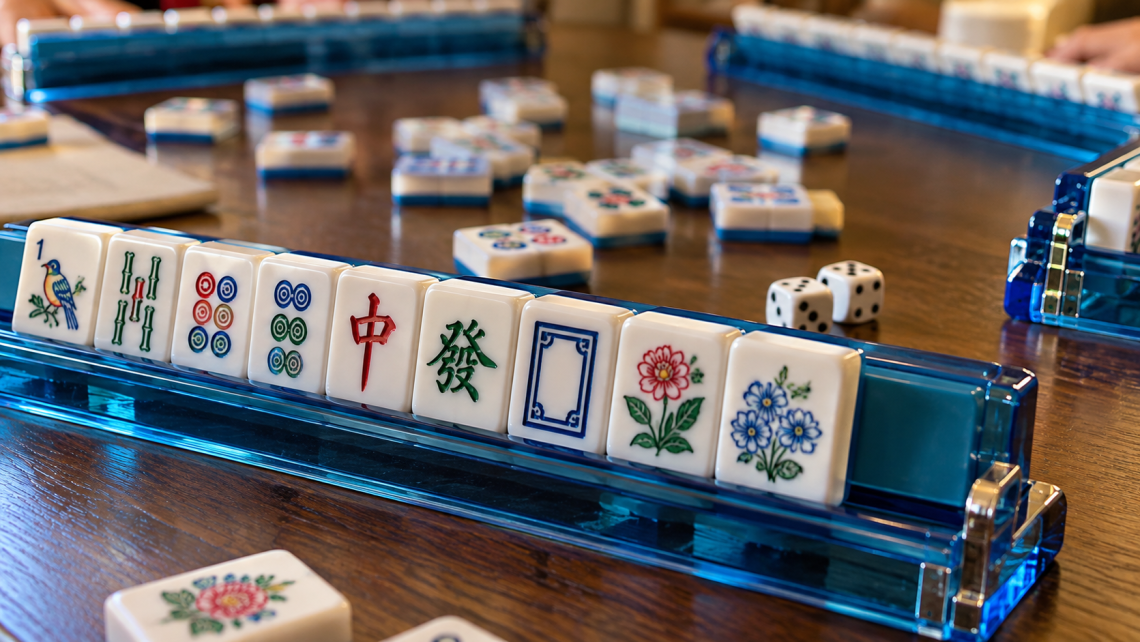
When Christina and Debbie invited me to a mah-jongg class they were hosting, I said, YES! —even though I knew absolutely nothing about mah-jongg.
Well, that isn’t entirely true. I knew there was a game on my phone called Mahjong where I matched little tiles until they disappeared.
As it turns out, this information was completely useless.
So… What Exactly Is Mah-Jongg?
For starters, the game I was learning was American mah-jongg, which is important information if you decide—as I immediately did—that you need your own fabulous set of tiles. You cannot just search “mah-jongg set,” find a pretty one, and assume you are ready to go. There are different versions of mah-jongg, and American mah-jongg uses 152 tiles, including eight jokers. So if you are buying a set to play American mah-jongg, make sure that is what you are actually buying.
Good to know. Especially before falling in love with a set based entirely on the color.
Not that I would do that.
cough
Real mah-jongg has tiles and racks and rules and strategy and a card filled with possible hands that, at first glance, looks a little like someone created a secret code just to see if you could figure it out.
Seriously. Numbers. Letters. Colors. Symbols. Parentheses.
What am I looking at?
And that card matters. In American mah-jongg, you aren’t simply trying to collect random matching tiles. You are building one of the specific hands printed on the card, which changes annually. So part of the game is looking at the tiles you have and deciding which possible hand you might be able to create.
That was probably the part I enjoyed most.
It was a puzzle.
But first I had to learn the vocabulary: craks, bams, dots, dragons, flowers, winds, jokers, and a Charleston.
Yes, the dance… but not really.
Craks, Bams, Dragons, and Soap
The numbered tiles come in three suits: craks, bams, and dots. Each suit is numbered one through nine, with four of each tile. Bams are bamboo, dots are circles, and craks are characters. Then there are North, South, East, and West winds; red, green, and white dragons; flowers; and those extremely useful jokers.
And because apparently this game wasn’t quirky enough already, the one bam usually has a bird on it, and the white dragon is often called “soap.”
Of course it is.
At one point, I was trying to remember which dragon went with which suit and found myself happily saying things like, “Bam dragon,” as though that were a perfectly normal phrase adults use in conversation.
It was hilarious.
Here is another thing I would have liked to know before showing up: you do not need to memorize all of this before going to a game night. Really. If someone invites you and is willing to teach you, GO.
You will learn by seeing the tiles, holding them, hearing people call them by name, and repeatedly asking, “Wait. Which one is that?”
Before play really gets going, everyone participates in something wonderfully called the Charleston, where players pass groups of tiles to one another. It reminded me a little of playing Hearts—except instead of passing cards, you are passing tiles and already trying to decide what you might want to keep.
Then you study your rack, study the card, study your rack again, look at the card again, and begin figuring out what hand you might actually be able to make.
Once the game begins, the basic rhythm is surprisingly easy to follow. You draw a tile, decide whether it helps, discard one you don’t need, and watch what everyone else throws away.
Very much like Rummikub—except all those tiles piling up in the middle of the table?
Just the discard pile.
The strategy comes from deciding which hand you are building, recognizing when you need to change direction, paying attention to what other people are collecting, and knowing when a discarded tile can help you.
And then there are jokers. Jokers really are wild tiles, but—because mah-jongg apparently enjoys making sure you never become too confident—they cannot simply replace anything anywhere. In American mah-jongg, they can be used in certain groups of matching tiles, but not for singles or pairs.
See?
Puzzle.
And Then I Won
I LOVE games, so once I began understanding how the pieces worked together, something clicked. I picked it up quickly.
Really quickly.
And then—I won a game.
Yay!
That may not sound particularly significant, but I spend a lot of my life in places where I’m expected to know what I’m doing. I taught school for twenty-five years. I teach Bible studies. I lead groups. I organize things. I make plans. I answer questions. I explain things.
Most of the time, I’m the person saying, “Okay, here’s what we’re going to do.”
So there was something wonderfully freeing about sitting down at a table and saying:
“I have absolutely no idea what I’m doing. Teach me.”
And then simply listening, watching, asking questions, laughing, and figuring it out.
Somewhere along the way, adults can get a little too comfortable staying with what we already know how to do. There’s a saying that floats around social media: “Be brave enough to suck at something new.”
There really is something to that.
Although, as it turns out, I didn’t suck at mah-jongg.
I won.
Okay, it was only one hand. Marsha and Jennifer each won one too.
Just wanted to make sure we remembered that.
But that wasn’t really the best part. The best part was showing up with no idea what I was doing and discovering that learning something new could still be this much fun.
What I’d Tell Another First-Timer
So if you have watched people play mah-jongg and thought, I have no idea what they are doing, here are my beginner observations: you do not have to understand that crazy-looking card before you go. You do not have to know a bam from a crak. You definitely do not need to buy a set before you know whether you like the game.
But if you DO buy one, find out which kind of mah-jongg your group plays first, because the sets are not all the same. And if it is American mah-jongg, look for a set with the American tiles—including those eight very important jokers—and four racks. The annual playing card is generally purchased separately.
Then find some patient people. Sit down. Ask questions. And play.
I learned that the matching game on my phone has basically been lying to me. I learned that craks, bams, dots, winds, dragons, flowers, jokers, and something called a Charleston can all somehow belong in the same game. I learned that saying “bam dragon” can be ridiculously funny with friends.
And I learned that I really, really want a beautiful blue mah-jongg set.
But mostly, I was reminded that it is good to do something just because it is fun—to learn something new, to laugh with friends, and to play a game.
And I can’t wait to do it again.