Apparently, forgetting God’s faithfulness isn’t just a me problem. It’s been a people-of-God problem for a very long time.
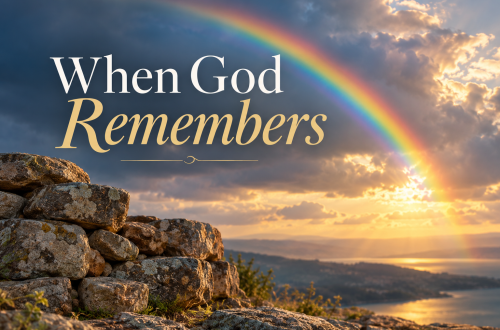
In the last post, When God Remembers, I suggested that maybe we need tangible reminders of God’s faithfulness—something we can look at and say, This is where God brought me through.
But really, that wasn’t my idea. It was God’s.
Be Careful That You Do Not Forget
Deuteronomy 8 finds the Israelites preparing to enter the Promised Land after forty years in the wilderness. For forty years, God had provided for them. He fed them with manna. Their clothes didn’t wear out. Their feet didn’t swell. Day after day, year after year, their very existence depended upon His provision. You would think forty years of that would make God’s faithfulness pretty difficult to forget.
Apparently not.
Moses warns them:
“Be careful that you do not forget the LORD your God…”—Deuteronomy 8:11
What strikes me about this warning is when Moses gives it.
He isn’t warning them that they will forget God when life gets hard. He warns them that they might forget Him when life gets good. They are about to enter a land where they will eat and be satisfied, build houses and settle down, and watch their herds, flocks, silver, and gold multiply. Somewhere in all that abundance, they might begin to think they did it themselves.
Moses even tells them what they might say:
“My power and the strength of my hands have produced this wealth for me.”—Deuteronomy 8:17
Look what I did.
So Moses tells them:
“But remember the LORD your God, for it is he who gives you the ability to produce wealth…”—Deuteronomy 8:18
Do not forget.
Remember.
In teaching women’s Bible studies over the years, I’ve often said that we tend to get our definitions of good and bad backward. We call something good when we get what we want and life is going according to our plans. We call something bad when life is painful, difficult, or simply not going the way we think it should.
But what if our circumstances aren’t the best measure of what is good?
When things are difficult, I am often much quicker to turn to God. I lean into Him. I call out to Him. I recognize how desperately I need Him.
But when everything is going according to my plan? That’s when I can begin to act like my own god. I’ve got this. I can handle it. I can create the life that makes me happy. I may even say, “God is so good!” when what I really mean is, God is doing everything I want Him to do.
That’s when I can become complacent, comfortable, and a little too satisfied with myself.
Maybe some of the things I most need to remember are the things that didn’t feel good at the time—the difficult places God brought me through, the prayers that weren’t answered the way I expected, the doors He closed, and the seasons when I had no choice but to depend on Him.
Maybe we don’t only need reminders of God’s faithfulness while we are waiting for Him to act.
Maybe we need them when everything is going just fine.
Gather Your Stones
Not long after Moses gave those instructions, the Israelites finally crossed into the Promised Land—without him, but that’s another story. And once again, there was water in the way. This time it was the Jordan River. As soon as the priests carrying the ark stepped into the water, God stopped the river, and the entire nation crossed on dry ground.
Then God told Joshua to do something interesting. He told him to choose twelve men, one from each tribe, and have each man take a stone from the middle of the Jordan. Those twelve stones were set up as a memorial.
Joshua explained why:
“In the future, when your children ask you, ‘What do these stones mean?’ tell them that the flow of the Jordan was cut off before the ark of the covenant of the LORD.”—Joshua 4:6–7
The stones were there because people forget. One day, children who had not crossed the Jordan themselves would see that pile of rocks and ask, Why are those there?
And someone would tell them the story.
Let me tell you what God did.
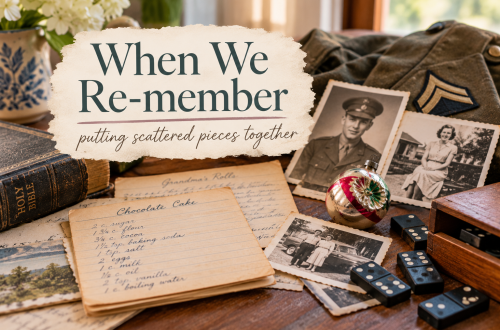
We do something similar. Our attics, closets, scrapbooks, and camera rolls are full of reminders of our lives—high school awards, diplomas, wedding photos, recipes in Grandma’s handwriting. We save things that remind us of people we love, places we’ve been, accomplishments we’re proud of, and gifts God has given us.
There’s nothing wrong with any of those things. They are part of our stories, and many of them remind us of God’s good gifts.
But the stones at the Jordan weren’t primarily there to remind Israel of what they had received. They were there to remind them of what God had done. Maybe I need to pay more attention to that difference.
What am I piling up stones to remember—God, or only His gifts?
Maybe I need to gather some different stones.
Write down the answered prayer. Keep the photograph. Mark the date in your Bible. Tell your children and grandchildren the story. Remember the provision you never expected, the door God opened, and the door He closed that needed to stay that way.
Re-member God’s faithfulness.
Gather the scattered pieces of His goodness and put them back together. But Scripture gives us another pile of scattered pieces.
These aren’t stones.
They’re bones.
Can These Bones Live?
In Ezekiel 37, God takes the prophet Ezekiel to a valley filled with bones.
Not bodies.
Bones.
And not neatly arranged skeletons, either. Ezekiel says the bones were scattered throughout the valley and were very dry. Whatever life had once been there was long gone.
God asks Ezekiel a question:
“Son of man, can these bones live?”—Ezekiel 37:3
I rather like Ezekiel’s answer:
“Sovereign LORD, you alone know.”
In other words, I’m certainly not going to say no, God, but I have absolutely no idea how You’re going to pull this one off.
I know that feeling.
My husband, Tom, recently started a job with a new company. Since we moved to Georgia, he had been working in a job he really hated, and I prayed for him every day—for a reason to keep going, some reassurance that God still had a purpose for him there, or an opportunity to leave.
For years, Tom applied for other positions without success. And at 61, we wondered how another company would hire him at the salary we needed, this close to retirement.
It became one of those prayers: Lord, I don’t know how You’re going to do this.
But God did.
The details are a story for another blog, but the short version is this: only God could have put those pieces together. Our job was to trust Him and be obedient even when we couldn’t see how He was going to do it.
God tells Ezekiel to prophesy to the bones, and then comes one of the most vivid scenes in Scripture. There is a noise—a rattling—as bone comes to bone. Tendons and flesh appear. Skin covers them.
The scattered pieces are put back together.
They are, quite literally for our purposes here, re-membered.
But there is a problem.
“There was no breath in them.”—Ezekiel 37:8
They had been put back together.
But they weren’t alive.
And suddenly I’m back where this entire series began.
Re-membered Isn’t Enough
In When We Re-member, I told you about David Dornstein’s journal entry:
“To be re-membered! Put back together from scattered parts.”
After David was killed in the bombing of Pan Am Flight 103, his brother Ken spent years gathering those scattered parts—David’s journals, letters, notebooks, unfinished writing, photographs, and the memories of people who had known him.
In a sense, Ken re-membered his brother. He gathered the pieces and put them together so that others could know something of who David had been.
But human remembering has a limit.
We can gather the pieces.
We cannot give them life.
That is the difference in Ezekiel’s valley. God doesn’t stop when the bones are back where they belong. He tells Ezekiel to prophesy to the breath.
“So I prophesied as he commanded me, and breath entered them; they came to life and stood up on their feet.”—Ezekiel 37:10
The vision is specifically about God’s promised restoration of Israel, but the image also points us toward something we see throughout Scripture about the character and power of God:
God gives life where there was death.
The bones were dis-membered.
God re-membered them.
And then He made them alive.
Dis-membered → Re-membered → Made Alive
The older I get, the more I realize how much of life involves letting go of what was and trusting God with what comes next.
We often want Him to put things back the way they were.
But God has a way of saying, “See, I am doing a new thing!” (Isaiah 43:19).
Let’s go!
Moving forward requires faith that He knows the way, has the plan, and will guide our steps—even when the new thing looks nothing like the old thing we wanted Him to fix.
God’s work isn’t about repairing the old at all.
It’s about making us new.
But God
That brings us to Ephesians 2.
Paul doesn’t describe us as people who were basically fine but needed a few pieces put back into place.
He says:
“As for you, you were dead in your transgressions and sins…”—Ephesians 2:1
Dead.
Not bruised. Not struggling. Not in need of a little self-improvement.
Dead.
And dead people cannot re-member themselves.
Then come two of my favorite words in Scripture:
But God.
Because of His great love and rich mercy, God “made us alive with Christ even when we were dead in transgressions” (Ephesians 2:4–5).
There it is again.
Life.
Noah stepped out of a world marked by death, and God told him to be fruitful and fill the earth. Rachel was remembered, and Joseph was born. Hannah was remembered, and Samuel was born. Israel cried out in Egypt; God remembered His covenant, acted, and brought His people out of slavery. Dry bones lay scattered in a valley; God spoke, God breathed, and they lived.
And we were dead in our sins.
But God made us alive.
I hear Christians talk about heaven—about trusting Jesus now and looking forward to glory someday. And of course, that hope matters. But something I have been learning more deeply is that God does not only save us for eternity. He is at work in us now.
He does more than save my soul. He saves my life—my moments, my days, even the way I understand what is happening around me.
Paul says in 2 Corinthians 4:16, “Though outwardly we are wasting away, yet inwardly we are being renewed day by day.” That renewal is not only for some distant future. God is at work in us every day.
He teaches us to see ordinary life through an eternal perspective. He gives joy in grief, comfort in pain, strength in weakness, and peace in the middle of trouble. He wants us to live now, not merely endure this life while waiting for glory.
And maybe that is part of what Jesus meant when He said He came so that we might “have life, and have it to the full” (John 10:10).
When God restores, He does more than collect scattered pieces and return them to where they used to be. He makes us alive.
What Are You Re-membering?
We come to one final twist in this word that has occupied far more space in my brain than I ever expected it to.
Scripture tells us that God remembers His people. He remembers His covenant. He remembers His promises.
But there is something God says He will remember no more.
In Hebrews 10:17, He says:
“Their sins and lawless acts I will remember no more.”
That doesn’t mean an omniscient God somehow deletes information from His memory. It means that because of Christ, our forgiven sin is no longer held against us.
And yet I can be remarkably good at remembering mine.
We have a tendency to carry our past around in a backpack that just keeps getting heavier—our failures, sins, pain, and regrets. Every once in a while, we pull something out, examine it again, remind ourselves how badly we failed, and wonder how God could possibly love us that much.
And sometimes, if we’re being truthful, a good pity party feels strangely satisfying.
But God doesn’t ask us to keep carrying what He has forgiven.
He tells us to put the backpack down.
God says He remembers my sin no more, yet I keep digging it back out. I replay conversations. I resurrect shame. I gather those scattered pieces and put them back together again.
Maybe I’ve been re-membering the wrong things.
If God has removed my sins as far as the east is from the west, why do I keep putting my past in a backpack and carrying it into my future?
There are things God tells me to remember.
And there are things He invites me to lay down.
Gather Your Stones. Put Down the Backpack.
So perhaps the question at the end of this series isn’t simply, What do you remember?
It’s:
What are you re-membering?
Are you gathering the evidence of God’s faithfulness—or reconstructing the evidence against yourself?
Are you remembering the places where God provided, sustained, protected, redirected, forgave, and carried you?
Where have you mistaken waiting for being forgotten?
And is there something in your life that looks so scattered, so dry, so thoroughly dead that you have decided even God cannot bring life to it?
Every day, God reminds me that He is completely aware of what I am doing, thinking, and feeling. The odd happenings, the “coincidences,” the little “God winks” remind me that He is here, He is real, He loves me, and He will provide what I need for today—my daily bread—and lead me into life to the full.
The bones in Ezekiel’s valley could not put themselves back together, and they certainly could not make themselves breathe.
But God spoke.
There was a rattling. Bone found bone. The scattered pieces came together.
And then God breathed.
The dead came alive.
That is where this whole series has been leading me. We began with re-membering—gathering scattered pieces and putting them back together. Then we looked at the God who remembers His people, His covenant, and His promises. And now, in Ezekiel’s valley, we see that God does more than remember and restore.
He gives life.
So gather your stones. Remember what God has done. Put down the backpack filled with the things He has forgiven. And when all you can see are dry bones, remember that what looks beyond hope to you is not beyond the reach of God.
We re-member because we are forgetful.
God remembers because He is faithful.
And God gives us life—a life worth living.