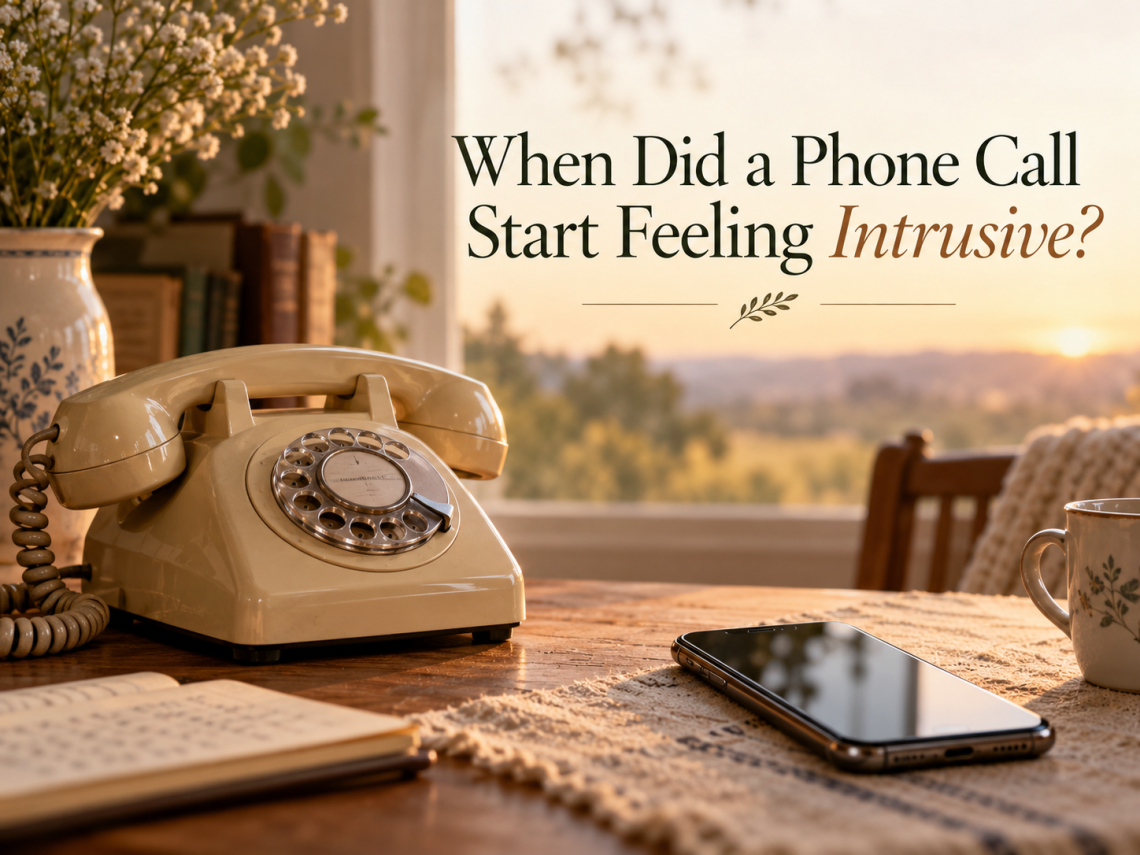
There was a time when the phone rang and you answered it. That was it. You didn’t know who was calling. You didn’t know why they were calling.
Crazy times! We were living dangerously!
Years later, caller ID gave us a hint about the identity of the caller, but you certainly didn’t get a text first asking, Are you free to talk? Is this a good time? or What is a good time for a call today?
Somewhere along the way, an unexpected phone call started to feel almost… intrusive.
Now, when my phone rings without warning, there is sometimes a moment of hesitation. Why are they calling? Is something wrong? Couldn’t they have texted me?
And apparently, I’m not the only one.
We Used to Just Call
There was no preliminary text, no appointment, and no warning. You called your friend because you wanted to talk to her. You called your mother because you had a question. You called someone because something funny happened and you wanted to tell the story while it was still funny. Sometimes you even called someone because you were bored.
Imagine that.
We had two phones in our home when I was growing up. TWO. One was on the wall between the kitchen and the family room, and the other was on the nightstand in my parents’ bedroom.
That’s it.
When a friend called, he or she had to speak with whoever answered the phone first. You meet a nice guy, you give him your number, and then you wait. Your heart jumps every time the phone rings.
Not him.
Not him.
And then—it is.
“Yes, this is she.”
Then I had two choices. I could take the call sitting on my parents’ bed, after making absolutely certain that my brother had hung up the downstairs extension before any real conversation began, or I could stretch that very long phone cord into the dining room or hallway in a desperate attempt to find some privacy.
And if that nice guy eventually became the boyfriend, that phone call could last for hours.
Maybe this is why ELO’s 1976 song “Telephone Line” feels almost quaint now. The whole emotional premise depends on calling someone, waiting for an answer, and wanting to hear the voice on the other end.
There was no “read” receipt. No three little dots telling you someone was typing. No carefully composed response arriving five minutes later.
There was just the telephone line—and the hope that someone would answer.
For those of us who grew up that way, a ringing telephone once carried possibility.
Now it can feel like an interruption.
Of course, communication has changed for some very good reasons. Texting is convenient. You text me when it is convenient for you, and I answer when it is convenient for me. I can think about what I want to say, and I can send information without interrupting whatever someone else is doing.
And usually, that is exactly what I want.
There are plenty of conversations that do not need to become phone calls. What time are we meeting? Do you need anything from the store? I’m running ten minutes late.
Perfect.
Send the text.
But texting gives us something else too.
Control.
We Can Edit Ourselves Now
When I write a text, I get to decide exactly what you receive. I can type something, delete it, rewrite it, soften it, add an emoji so you know I’m joking, remove the emoji because now it looks sarcastic, read the message again, decide it sounds strange, rewrite the entire thing, and then finally hit send.
A conversation doesn’t give us that luxury.
When we talk to someone, the words happen in real time. There are pauses, awkward moments, interruptions, and stories that go somewhere we didn’t expect. Sometimes there are even a few seconds of silence while neither person knows quite what to say next.
And perhaps that is part of what makes an actual conversation different.
It is less controlled.
But I also think there are fewer opportunities for misinterpretation when we can actually hear one another. A text can be misread. Tone can be misunderstood. Assumptions can be made. A short response can sound angry when the person was simply busy, and a joke can sound harsh without the smile or laugh that would have accompanied it.
And once the misunderstanding is there, we have the added pleasure of having it preserved in writing so we can read it, reread it, analyze it, and stew over it.
Sometimes a five-minute conversation could have prevented the entire thing.
There Is Something About Hearing a Voice
A text can tell me what you said, but your voice can tell me so much more. I can hear whether you are tired. I can hear hesitation. I can hear laughter that would have been reduced to “LOL.” I can hear the little change in your voice that tells me you are saying you’re fine when you probably aren’t.
There are things we communicate without ever putting them into words.
Maybe that is one reason Scripture so often describes relationships in terms of being with one another rather than simply exchanging information. We were created for connection that involves more than carefully composed sentences on a screen.
And the just because call may be the best kind. No emergency. No agenda. No information that needs to be exchanged. Just someone saying, in essence, I was thinking about you and wanted to hear your voice.
There is something priceless about having the freedom of a one-on-one conversation with a friend and letting it go wherever it goes.
Several years ago, I realized that I had not been very faithful about calling my mother. We communicated. I sent her information when I needed to. She sent information back. And most of that happened by text.
But that was the problem.
We were communicating information.
We weren’t necessarily talking.
So I made a small change. I teach Women in the Word every Tuesday evening, and on my way home, I call my mom.
Every. Tuesday. Evening.
No text first. No appointment. I get in the car, start the engine, and say, “Hey Siri, call Mom.”
We can do this, people. Hands-free. From the car. Making the call.
And yes, she expects it now.
That has become part of our rhythm. There may be nothing particularly profound about a weekly phone call, but I have learned that relationships are often strengthened by small acts of intentional faithfulness.
Sometimes love sounds like, “Hey Siri, call Mom.”
Maybe the Real Issue Is Interruption
I wonder if the problem isn’t really the phone call.
Maybe it is the interruption.
We have become very good at deciding when people have access to us. Texts can wait. Emails can wait. Messages can sit unread until we are ready. A phone call, however, arrives right in the middle of whatever we are doing and asks us to make a decision: Will you stop what you are doing and give this person your attention?
And no, we cannot always do that.
There are legitimate boundaries. There are meetings, family dinners, appointments, quiet moments, and work that needs concentration. Sometimes the loving thing really is to say, “Can I call you later?”
But I wonder whether I have become so accustomed to controlling access to my time that every interruption begins to feel like an inconvenience.
That question reaches far beyond the telephone.
Jesus Was Interruptible
When I read the Gospels, I am struck by how often Jesus appears to be on His way somewhere when someone interrupts Him.
In Mark 5, Jairus begs Jesus to come to his home because his daughter is dying. Jesus goes with him, but on the way, a woman who has been suffering for twelve years reaches through the crowd and touches His garment.
Jesus stops.
There is already somewhere He needs to be. There is already someone waiting for Him. The need is urgent.
And still, He stops.
He sees her. He speaks to her. He gives her His attention.
Jesus does not treat people as interruptions to His ministry.
Very often, the interruption is the ministry.
That does not mean Jesus had no boundaries. He withdrew to pray. He rested. He moved away from crowds. He did not respond to every demand exactly when people wanted Him to.
But He was present.
That challenges me, because sometimes I can become so protective of my plans, my schedule, and my attention that another person’s need feels less like an opportunity to love them and more like something disrupting what I intended to do.
Love Is Not Always Convenient
Paul writes in Romans 12:10, “Be devoted to one another in love. Honor one another above yourselves.”
And in Philippians 2:4, “not looking to your own interests but each of you to the interests of the others.”
Those verses are easy to admire.
They are sometimes much harder to practice.
Loving people inevitably costs us something. Sometimes it costs money. Sometimes it costs energy. Sometimes it costs convenience. And sometimes it costs twenty minutes we had planned to use for something else.
Paul’s words do not mean that we must answer every phone call, respond immediately to every message, or make ourselves endlessly available to everyone. That would not be wisdom.
But they do make me ask a harder question:
Have I become so protective of my own time that another person’s need automatically feels like an intrusion?
There is a difference between having healthy boundaries and arranging my life so carefully that no one is ever allowed to interrupt it.
Love makes room. Love notices. Love listens. Love sometimes sets aside what I intended to do because the person in front of me—or on the other end of the phone—is more important in that moment.
Maybe the real question is not whether I prefer calls or texts.
Maybe it is whether I am willing to be available when someone needs me.
Maybe We Don’t Need to Bring Back the Three-Hour Phone Call
I am not suggesting that we abandon texting, and I’m certainly not suggesting that every phone call needs to be answered immediately. Sometimes a text first really is considerate: Do you have a minute to talk?
There is nothing wrong with that.
But maybe the change in our communication habits gives us something worth noticing. We have more control than ever over when people can reach us. We can silence notifications, screen calls, delay responses, and compose and edit our words before anyone sees them.
All of those things can be useful.
But relationships have never been particularly efficient. People interrupt. Conversations wander. Stories take too long. Someone needs to talk when we were planning to do something else.
And sometimes the most loving thing we can give another person is not the perfect response.
It is our presence.
Our attention.
Our voice on the other end of the phone saying, “I’m here.”
If you call me, I will answer. If I miss your call, I will call you back.
However—and here is the irony—I will typically send you a text first before I call you: Do you have a minute? Is this a good time?
Being an entrepreneur has taught me to schedule phone calls and respect other people’s time, and maybe that is not a bad thing.
Perhaps the goal is not to return to a time when everyone answered every ringing telephone. Perhaps it is simply to remember that people are worth our time—even when their timing is not especially convenient.
And really, we have it much easier now. We can have those long conversations without holding a receiver between our ear and shoulder until we develop a crick in our neck. Speakerphone. Bluetooth. Hands-free calling.
We have eliminated almost every excuse.
I know this much: every Tuesday evening, when I leave Women in the Word, I will start my car and say, “Hey Siri, call Mom.”
And someday, I suspect I will be very glad I did.
So maybe the question isn’t whether you are a phone-call person or a text-first person.
Maybe the better question is:
Who do you need to call?
Not because you need information.
Not because something is wrong.
Just because you want to hear their voice.
Go ahead.
Make the call.