I’ve always thought that one of the best ways to identify the idols in our lives is to pay attention to our fears.
What am I afraid of losing? My family? My financial security? My health? My independence? My reputation? My comfort? My ability to make my own decisions?
Sometimes the things we are most afraid of losing reveal the things we are holding onto most tightly. Recently, as I was preparing to begin our No Other Gods study, I was reading David Powlison’s article, “The Sufficiency of Scripture to Diagnose and Cure Souls,” when one sentence made me stop and think:
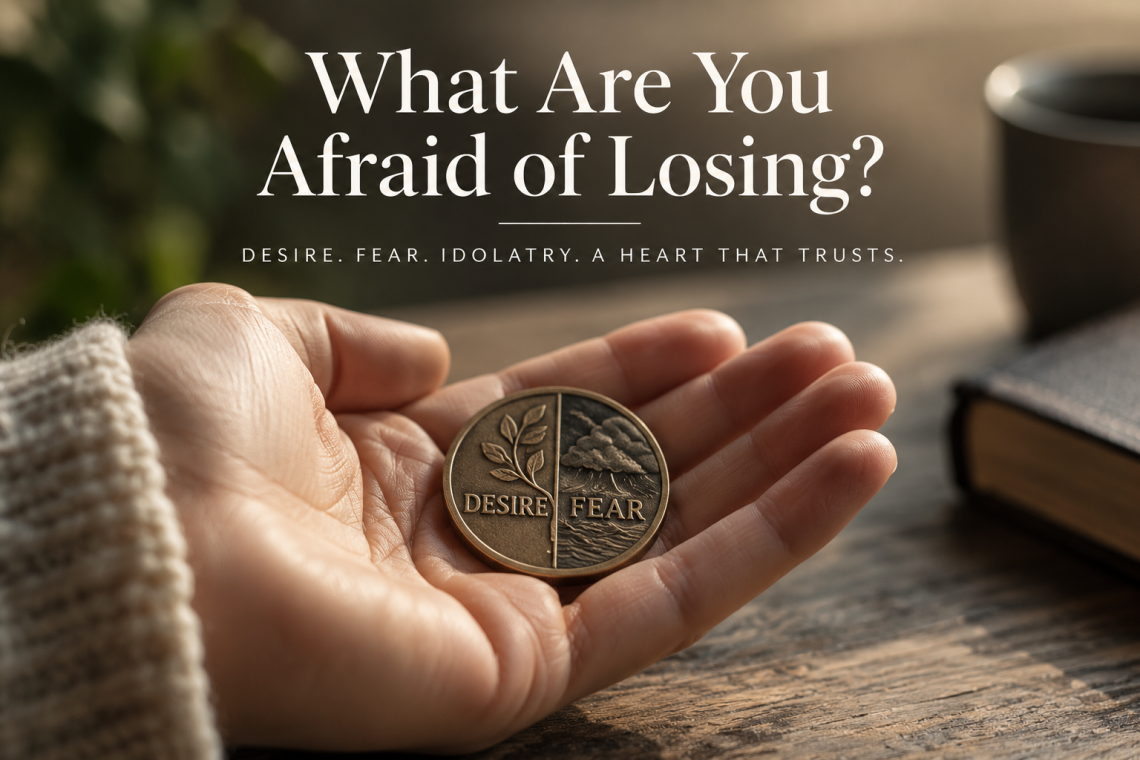
“Fear and desire are two sides of a single coin.” —David Powlison
That makes sense. If I desperately want something, I may fear that I’ll never get it. And if I finally get it, I may become afraid that I’ll lose it.
Same coin.
When a Good Thing Becomes Too Important
When we hear the word idol, most of us probably picture a little carved statue sitting on a shelf somewhere. That makes idolatry fairly easy to dismiss.
I don’t have any statues. (No, those little “Jesuses” don’t count.)
Check. No idolatry here.
Except…
Scripture’s picture of idolatry goes much deeper than bowing down to a physical object. An idol can be anything in creation that begins to occupy a place in our hearts that belongs to God alone. That means our idols aren’t necessarily bad things. In fact, some of the most powerful idols in our lives may be very good things.
Family is good. Marriage is good. Financial stability is good. Health is good. Friendship is good. Ministry is good. There is nothing sinful about wanting any of those things.
The problem isn’t necessarily what I want. The problem may be how much I need to have it.
A good desire can quietly become a demand. I would really like this becomes I need this, which eventually becomes I cannot be okay without this. Somewhere along the way, a good gift has begun doing a job it was never intended to do.
Follow the Fear
That’s where fear can become revealing.
If I crave financial security, I may fear poverty. If I crave approval, I may fear rejection. If I crave control, I may fear uncertainty. If I crave comfort, I may fear suffering. If I crave success, I may fear failure. And if I desperately want the people I love to be safe, I may become consumed with all the terrible things that could happen to them.
The desire and the fear are connected. One says, “I have to have this.” The other says, “I cannot let this be taken away.” And both may be revealing what my heart is trusting to give me security, peace, significance, or satisfaction.
Are Fear and Concern the Same Thing?
Let’s not get crazy…
If I want to keep my husband safe and healthy, that doesn’t automatically mean my husband is an idol. If I receive a serious medical diagnosis and feel concern, that doesn’t mean I have made an idol out of my health. If my child is in danger, alarm is an entirely appropriate response.
We love people. We value God’s good gifts. We would like to keep them.
But concern and fear are not necessarily the same thing.
Concern recognizes that something valuable may be threatened and responds appropriately. Fear can take that concern and run with it. It begins imagining outcomes, demanding guarantees, grasping for control, and living as though everything depends on me.
Scripture has quite a lot to say about that kind of fear. Again and again, God tells His people, “Do not fear.” Not because there is never anything frightening in front of them, but because He is with them.
“Fear not, for I am with you; be not dismayed, for I am your God.” —Isaiah 41:10
So perhaps the better question isn’t simply, What am I afraid of losing?
Instead, it could be:
What does the possibility of losing this reveal about what I believe I need in order to be okay?
That question goes a little deeper. What happens in my heart when the thing I value is threatened? Do I move toward God in trust—or become consumed by anxiety? Do I become angry when God doesn’t give me what I think I need? Do I try to control people or circumstances to guarantee the outcome I want? Do I begin to question God’s goodness?
The disciples did.
When a violent storm threatened to swamp their boat while Jesus slept, they woke Him with a question that revealed more than their fear of the storm:
“Teacher, do you not care that we are perishing?” —Mark 4:38
The storm was real. The boat really was filling with water. Their concern wasn’t imaginary or unreasonable. But somewhere between This is dangerous and Do you not care?, their fear began to challenge what they knew about Jesus.
After calming the storm, Jesus asked them:
“Why are you so afraid? Have you still no faith?” —Mark 4:40
Maybe that’s another question worth asking ourselves. When something I value is threatened, does my fear eventually lead me to wonder, God, don’t You care? Do I believe that if this doesn’t happen—or if that is taken away—I simply cannot be okay?
Concern says, “This matters to me.” Fear may reveal, “I have to have this.”
And that is where fear can begin to expose an idol. Those questions can be uncomfortable, but they can also be incredibly revealing.
What Is Functioning as My God?
There is a difference between the God I profess and the god that sometimes functions as my god.
Second Kings gives us a rather startling picture of what that can look like:
“So they feared the LORD but also served their own gods.” —2 Kings 17:33
Read that again.
They feared the LORD, AND they served their own gods.
Apparently, acknowledging the Lord and having other gods are not mutually exclusive. At least, we can convince ourselves they aren’t. And this wasn’t a temporary inconsistency. Later in the chapter we read:
“So these nations feared the LORD and also served their carved images. Their children did likewise, and their children’s children—as their fathers did, so they do to this day.” —2 Kings 17:41
That’s uncomfortably close to home.
Notice that their divided worship didn’t stop with them. Their children did likewise. And then their grandchildren. The next generation learned what it looked like to acknowledge the Lord while still depending on other gods.
As parents and grandparents, that should get our attention. We have a responsibility not only to tell our children and grandchildren that God is trustworthy, but to demonstrate what trusting Him looks like. They are watching what we do when money is tight, when plans change, when someone we love is struggling, when the future is uncertain, and when we simply cannot control the outcome.
What am I teaching them about God by the way I respond to the things I fear?
I can sincerely say that God is Lord of my life and yet live as though my security depends on the number in my bank account. I can say that I trust God with my family while desperately trying to control every circumstance surrounding the people I love. I can say that my identity is in Christ while allowing someone else’s approval—or disapproval—to determine how I feel about myself.
If the people closest to me watched only the way I live—and never heard what I say—what/who would they conclude I trust?
I may not have a carved image sitting on my shelf, but that doesn’t mean something else isn’t competing for the place that belongs to God.
My theology may say one thing while the way I actually live reveals another.
Jesus said,
“For where your treasure is, there your heart will be also.” —Matthew 6:21
Maybe one way to discover where my treasure is located is to notice what I am desperately trying to obtain—or desperately trying to keep.
What am I serving with my time, energy, thoughts, emotions, and resources? And perhaps even more revealing: What am I terrified of living without?
That may tell me something about what is actually functioning as my god.
Turn the Coin Over
So perhaps identifying our idols requires looking at both sides of the coin.
What do I desperately want?
Turn it over.
What am I desperately afraid of?
Then ask: What do those two answers have in common?
Maybe I want people to think well of me—and I’m terrified of disappointing them. Maybe I want financial security—and I’m constantly worried about money. Maybe I want my children to make good choices—and I’m consumed with fear about decisions I cannot make for them. Maybe I want everything to work according to my carefully constructed plan—and uncertainty makes me anxious.
There may be something underneath both the desire and the fear that deserves my attention.
Not so I can stop loving good things. Not so I can become indifferent to loss. And certainly not so I can pretend painful things aren’t painful. But so I can hold God’s gifts with open hands instead of clenched fists.
The goal isn’t to stop wanting. It is to learn to say:
“God, I want this. I may even want it very much. But I want You more.”
And when fear comes:
“God, I don’t want to lose this. But if I do, You will still be God. You will still be good. And You will still be enough.”
Those are fairly easy words to write when the things I love are still safely tucked inside my open hands.
Job actually had them taken away—his possessions, his livelihood, his children, and eventually even his health. And somehow, in the middle of unimaginable loss, Job could say:
“The LORD gave, and the LORD has taken away; blessed be the name of the LORD.” —Job 1:21
But Job’s story also reminds us that trusting God when we lose something precious doesn’t mean we don’t grieve, question, hurt, or struggle.
And perhaps that’s a question for another day:
What happens when whatever I’m afraid of losing is actually gone?
For now, maybe our fears really do tell on us sometimes. And perhaps that’s a mercy.
Because when God shows us what our hearts have begun to worship, He isn’t merely pointing out an idol.
He’s calling our hearts back to Himself.