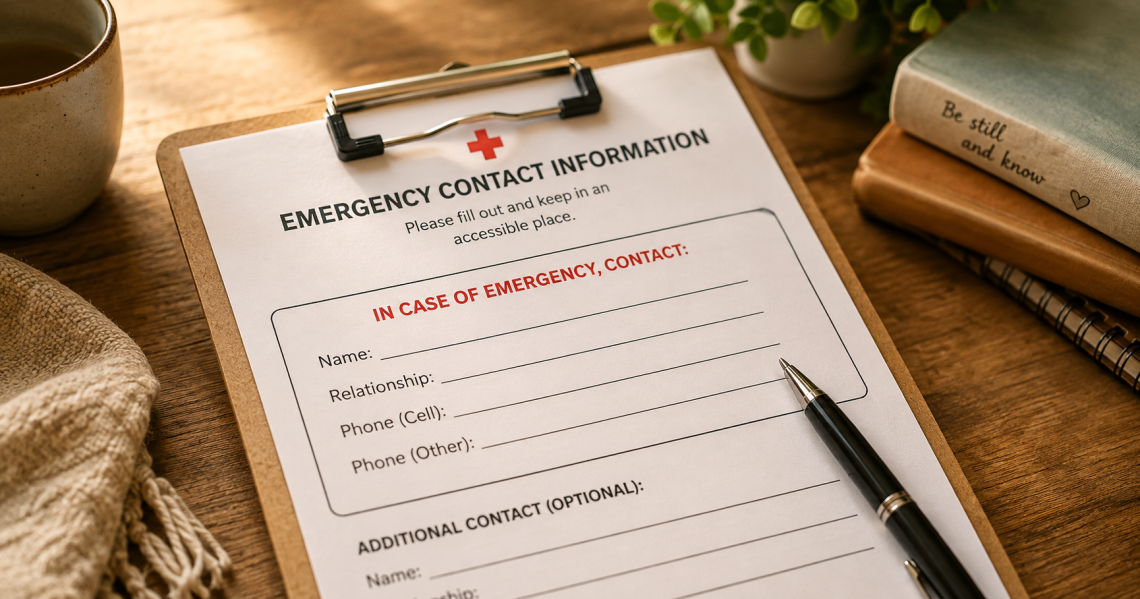
Emergency Contact
Who is your emergency contact?
You know—the person whose name you write on all those forms. The person someone should call if something happens to you and you can’t make the call yourself.
It’s actually a pretty important designation.
If you’ve ever watched The Big Bang Theory, you may remember the Valentine’s Day episode when Sheldon gives Amy what may be the most Sheldon Cooper romantic gift imaginable.
Amy has released him from all Valentine’s Day obligations, which, naturally, makes Sheldon very happy. But he has something for her anyway.
His employee information form.
At first, Amy doesn’t understand why this qualifies as a gift. Then Sheldon directs her attention to the bottom of the form.
In case of emergency, please contact: Amy Farrah Fowler.
And there’s her phone number.
Amy is overwhelmed. For Sheldon, this is a significant step in their relationship. If something happens to him, she is his person.
Of course, Sheldon quickly ruins the romantic moment by telling her to stop ruining Valentine’s Day and order his pizza.
Throughout life, that person changes.
When Your Emergency Contact Changes
As a child and young adult, my emergency contact was my mother. Definitely not my dad. Oh, my dad was great—but if I had an emergency, I wanted my mom. She was also always available to pick me up from school when necessary.
Then I got married.
I remember completing my first employee emergency contact form and putting my husband, Tom, first and my mom second.
Eventually, my children became adults and could be listed as my secondary emergency contacts.
Now that was weird.
I have no doubt that someday my granddaughter Emma will become my emergency contact.
Probably on my nursing home registration form.
But here’s something I had never really considered:
What if your family knows how to take care of you in an emergency—but has no idea how to take care of the rest of your life?
But Who Does Your Family Call?
Several years ago, I was in a rather serious car accident. Fortunately, I was able to call Tom myself.
And Tom knew what to do.
He knew where I worked. He knew my coworkers, and they knew him. He could call the school and tell them what had happened and that I wouldn’t be there.
The same was true for me. I knew where Tom worked. I knew how to reach his coworkers. If something happened to him, I could make a phone call or walk into his workplace and say, “Tom has had an emergency. You shouldn’t expect him today.”
Simple.
Then I started working remotely.
During the pandemic, I taught online courses for three different schools. My office was in my house. My coworkers weren’t people Tom saw at faculty Christmas parties or school events. He didn’t know my supervisors. He didn’t have their phone numbers.
And one day I had a rather unsettling realization.
If I died at my desk, Tom wouldn’t know whom to call.
Eventually, someone would notice.
I suppose my conscientious students would begin wondering why I hadn’t graded their work or commented on their discussion posts. Eventually, one of them would probably contact an administrator.
“Has anyone heard from Dr. Peterson?”
That’s not exactly an ideal emergency notification system.
I had an emergency contact listed with my employers.
But what I needed was the reverse.
My family needed an emergency contact for my work.
Someone needed to know whom to call if I suddenly couldn’t make that call myself.
Remote work made the problem obvious to me, but it isn’t limited to remote employees.
Maybe you own a small business. Maybe you freelance. Maybe you lead a ministry. Maybe you volunteer somewhere that depends upon you every week. Maybe you’re responsible for something that your spouse or children know very little about.
If you suddenly couldn’t communicate, would the people closest to you know whom to contact?
It doesn’t require an elaborate emergency binder or detailed instructions for every possible catastrophe. Just make sure someone in your family knows the basics:
- Where do you work or serve?
- Who needs to know if you suddenly can’t be there?
- What is that person’s phone number or email address?
- Is there anyone else who should be notified?
We spend plenty of time deciding whom our workplace should contact if something happens to us.
Maybe we should spend a few minutes making sure our families know whom to contact, too.
And if there’s someone special enough to make that list, you might even want to tell them.
Just don’t present the information as a Valentine’s Day gift.