I have been a teacher for a very long time. I remember when students would ask me, “Where were you when Kennedy was shot?” I guess that was the moment their parents talked about—the moment everyone of their generation remembered exactly where they were and what they were doing.
My students were always a little incredulous when I told them I hadn’t even been born yet. Teenagers assume all adults are equally old.
Today, we have an entire generation of adults who weren’t alive on September 11, 2001, and many more who were too young to remember it. Those of us who do remember need to keep telling our stories. Eventually, firsthand memories become history.
This is mine.
On September 11, 2001, I was a teacher at a private Christian school in Hagerstown, Maryland. I was the homeroom teacher, Bible teacher, and advisor for the senior class, so my seniors and I were together getting ready to start the day. I remember that I wasn’t actually teaching at that moment. The students were doing different things, and I was sitting at my desk.
One of my students, Ben, needed to go to the office for something. I wrote him a pass, and he went on his way. When he came back, he told me that the people in the main office were watching the news. A plane had flown into one of the Twin Towers in New York City.
I remember being confused. How could a plane accidentally fly into a building?
I pulled out our TV cart—yes, a TV cart—and turned on the news. My students and I stood there watching the coverage. I was the teacher. I was supposed to know what to say and what to do, but I didn’t. There wasn’t anything in my teacher training that told me what to say to a room full of teenagers while we watched something none of us understood.
So I did the one thing I knew to do. I asked one of my senior boys, Jason, to pray. Pray for the people on the plane. Pray for the people in the building. Pray for all the things we didn’t know.
And there was so much we didn’t know.
As the morning went on, another plane hit the second tower. Then the Pentagon. Then we learned about Flight 93 in Pennsylvania. Then the towers began to fall. Whatever confusion there had been at the beginning was gone. This was no accident.
My two children attended the school where I taught, so they were in the building with me. I didn’t have to wonder where they were, but I completely understood the parents who began arriving at school to pick up their children.
When the world seems to be on fire, you want to have your children with you. Families want to be together.
None of us knew exactly what to do that day, including the people in charge. Looking back, I still wish some things at our school had been handled differently. Students were moved from room to room and eventually gathered together in the gym while parents continued arriving to take them home. We were all improvising. No one had prepared for this.
Eventually, I went back to my classroom and began cleaning up and packing things away. I remember thinking that we might be home for a while because we simply didn’t know what was going to happen next.
That may be one of my strongest memories of September 11—the uncertainty. Were we at war? With whom? Was this over? Was something else coming? Where would they strike next?
Eventually, all of the students had been picked up, and we were allowed to leave too. We went home and, like millions of other Americans, kept watching television as the stories unfolded.
I’m not a worrier. I’m really not. If I can’t control something—if there is genuinely nothing I can do about it—I don’t tend to fret about it. Sometimes people interpret that as my not being concerned. I am concerned. I just don’t see the point in working myself into a frenzy over something I cannot change.
So I don’t remember being frightened as much as I remember being sad and disappointed. Somehow, even before we understood everything that had happened, I knew that the world we had known that morning was gone. Things were going to change, and we were going to have to change with them.
When people find out that I’m from the Washington, D.C., area, they sometimes ask me about visiting the monuments, especially if they’ve never been there. I tell them what it used to be like. We could just get in line for a White House tour. We could decide to go to the top of the Washington Monument on a whim—and then WALK down the steps! Yes, I walked down the steps inside the Washington Monument with my grandmother.
We could take someone to the airport and walk right to the gate with them. We could sit there together until it was time for them to board the plane. We didn’t think much about those freedoms. They were simply part of life.
Until they weren’t.
Sometimes you don’t know what you have until it’s gone.
Twenty-five years later, perhaps that is one of the things September 11 still has to teach us. Appreciate today. Appreciate the people sitting at the table with you. Appreciate the ordinary routines that seem so ordinary you barely notice them. Appreciate the freedoms you assume will always be there.
Because we don’t know what tomorrow holds.
And maybe that’s the other thing I learned that day.
I was standing in a classroom with a group of high school seniors when history interrupted an ordinary Tuesday morning. I was the teacher. I was supposed to know what to say and what to do.
I didn’t. None of us did.
But God did.
Nothing that happened that morning surprised Him. While we were asking, What is happening? What do we do now? What comes next? God was still God. He had not lost control. He wasn’t scrambling to make sense of what had happened or wondering what tomorrow would bring.
We couldn’t see what was ahead. He was already there.
And when there seems to be no direction—when everything familiar suddenly changes and we don’t know which way to go—He is still the One who can lead us. Maybe that’s why one of my clearest memories from that morning is asking Jason to pray. I didn’t have answers to give my students, but I knew Who did.
Twenty-five years later, I know that was the right thing to do.
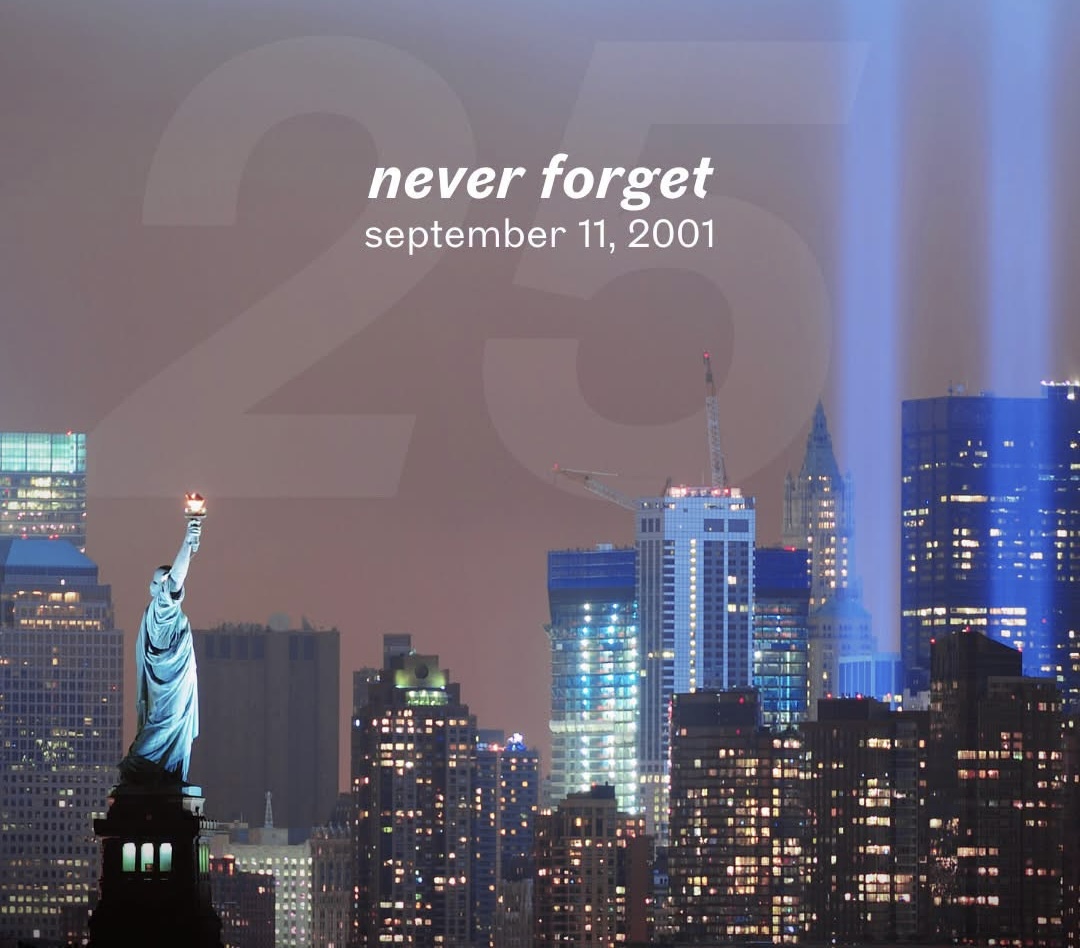
Maybe that’s part of what it means to Never Forget.
We remember the nearly 3,000 people who left home that morning expecting to come back. We remember the first responders who ran toward danger while everyone else was trying to escape it. We remember those whose lives and health were affected for years afterward. We remember the families who would have given anything for one more ordinary morning.
We remember how quickly the things we take for granted can become the things we wish we had appreciated more.
And we remember that when our world changes without warning, God does not.
So perhaps remembering September 11 should change the way we live on September 12—and September 13—and every ordinary day we’re given after that.
Appreciate today. Hold your people close. Remember what matters. Trust the God who holds tomorrow.
I remember where I was.
Where were you?