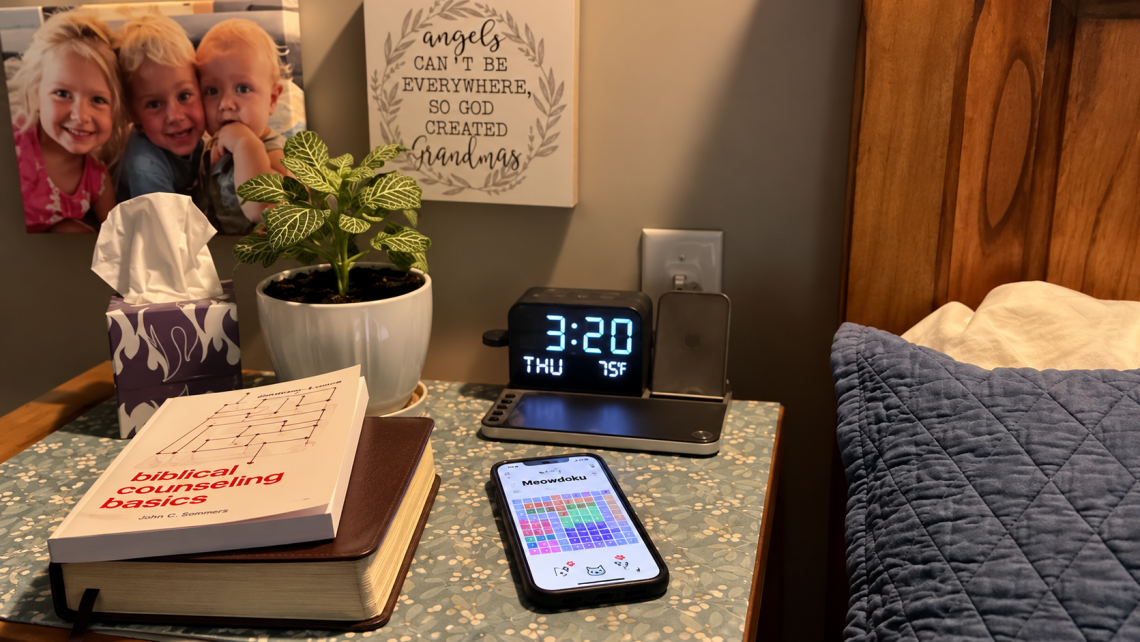
It was 3:00 in the morning, and I couldn’t sleep.
This isn’t particularly unusual for me. Sometimes my brain simply refuses to turn off. Thoughts bounce around, one leads to another, and before long I’m thinking about twelve different things—none of which are helping me go back to sleep.
So I picked up my phone and started playing a puzzle game. My favorites right now are Block Buster, Cube Away, and Meowdoku. (Yes, I know. They’re cats.)
That might seem counterproductive. If you can’t sleep, aren’t you supposed to put the phone down?
Probably.
But I’ve discovered something strange about the way my brain works. Sometimes, when there is too much going on in my head, I need to give my brain one thing to do. A puzzle makes me concentrate on something small and contained. Instead of thinking about everything, I have to think about this. In fact, the more difficult the puzzle is to solve, the better my brain seems to like it.
Eventually, my brain settles down.
The funny thing is, I do exactly the same thing when I’m getting ready to write.
Apparently, Ray Barone and I Have the Same Brain
Years ago, I was watching an episode of Everybody Loves Raymond. Ray, a sportswriter, had gone down to his basement office to write his column.
Except he wasn’t writing.
He was playing a video game.
Debra caught him and, understandably, wanted to know why he was goofing off when he was supposed to be working. Ray tried to explain that playing the game was part of getting himself ready to write.
I remember watching that scene and immediately thinking:
YES! That’s me!
I will never forget that moment. Until then, I thought needing to play a little Candy Crush before working on a paper was just weird. (Yes, I’ve always been in school.) But suddenly there was Ray Barone doing the same thing. Someone—whoever wrote that episode—apparently had a brain like mine. I understood exactly what Ray meant.
Sometimes I can’t go directly from whatever else I’m doing into writing. I need a transition. I need to focus my brain on something completely unrelated for a little while before I can focus it on the words.
From the outside, it looks like I’m wasting time.
But sometimes I’m getting ready to work.
And sometimes I’ve actually been working for hours.
I’ve Been Working on It All Day
Years ago, when I was working on my dissertation, Tom asked me whether I had been working on it that day.
He found me in the kitchen, just piddlin’, as Southerners say—not really accomplishing much of anything. I was stuck in the review of literature section of my dissertation, and I needed to let it marinate for a bit. I told him I had been working on one particular section all day.
The problem was, I hadn’t actually been sitting at the computer working on it.
I had been working on it in my head.
And I meant it.
I had been turning the idea over, arranging it, questioning it, making connections, deciding what belonged and what didn’t. There may not have been a single new sentence on the page yet, but the work was happening.
I’ve always called that “noodling.”
I noodle an idea. Sometimes for a few hours. Sometimes for days. Occasionally much longer.
An idea will bounce around in my brain while I’m driving, cleaning, taking a shower, playing a game, watching television, or doing something that appears to have absolutely nothing to do with writing.
Last week, I was teaching the ladies in Women in the Word from Isaiah 44 about the foolishness of people creating their own idols. Isaiah describes a carpenter who takes wood, uses part of it to build a fire, and then uses the rest to fashion a god.
A carpenter.
Which made me think of another Carpenter.
Jesus.
Right there while I was teaching, I told the ladies that the idea was knocking around in my brain. I knew there was something there, but I didn’t know exactly what it was yet.
I needed to noodle it for a while.
Eventually, something clicked. The carpenter who makes himself a god collided in my mind with the Carpenter who is God—and the blog God Is God and I Am Not was born.
But it existed in my head before it existed on the page.
So When Did the Writing Begin?
That’s what I’ve been wondering.
We tend to think writing begins when someone sits down at a keyboard and types the first sentence.
I’m not sure mine does.
Maybe the typing is simply the first visible evidence of something that’s already been happening.
Before I write, I collect. I connect. I rearrange. I argue with myself. I hear sentences in my head and decide I don’t like them. An illustration suddenly connects with a Scripture passage. Something I read three weeks ago bumps into something someone said yesterday. A memory I haven’t thought about in years suddenly belongs in the middle of an idea I’ve been carrying around.
I’m not typing. But I’m writing. Or at least I’m noodling.
This morning, I was reading Galatians 5:
“It is for freedom that Christ has set us free. Stand firm, then, and do not let yourselves be burdened again by a yoke of slavery.” —Galatians 5:1
Since then, I’ve been connecting that verse in my mind to the work we’ve been doing in No Other Gods.
We are free in Christ.
He has freed us from the burden of sin.
God freed the Israelites from slavery in Egypt.
A yoke of slavery.
Freedom. Idolatry. Egypt. Bondage. Christ.
The connections are swirling. Ideas are growing. It’s almost as though they’re dancing around one another in my mind, and while they do, my eyes and ears are looking for more information to add to the choreography.
Eventually, I trust, they’ll come together into something I need to share.
I’m noodling.
And perhaps that’s why the puzzle games work, too. Sometimes I need something simple enough to occupy one part of my brain while the rest of it settles. Other times, I need the game to help me transition from a dozen competing thoughts to one sustained train of thought.
I’m beginning to think that what looks like distraction isn’t always distraction.
Sometimes it probably is. Let’s not get carried away. I am perfectly capable of wasting time with the best of them.
The Work No One Can See
There’s something about this that reaches beyond writing.
We tend to measure work by what we can see.
Pages written. Boxes checked. Tasks completed. Something produced.
But much of the work that eventually produces visible change happens long before anyone else can see it.
Think about someone trying to lose weight. She may have spent weeks changing the way she eats, making different choices, turning down things she would normally have eaten, and getting up every morning determined to do it again—sometimes for weeks before anyone says, ‘Have you lost weight?’”
Or someone trying to get into shape. Long before the muscles are visible or the clothes fit differently, her body is changing. She is getting stronger. Her endurance is improving. The work is already producing something, even though nobody else can see it yet.
Maybe that’s true of far more of life than we realize.
In my studies in biblical counseling, I’ve been learning the same thing about spiritual transformation. True transformation works from the inside out. Biblical counseling isn’t simply about behavior modification—teaching someone to act the way a Christian is “supposed” to act. The Word of God works in the heart and mind, and the Holy Spirit uses that Word to change us.
And much of that work may be invisible at first.
A person begins recognizing an idol she couldn’t see before. She starts questioning something she has always believed. A Scripture she has read dozens of times suddenly confronts the way she has been thinking. Her desires begin to change. She responds differently once—and then falls back into the old pattern—and then tries again.
Someone looking from the outside may not see much happening at all.
But that doesn’t mean nothing is happening.
If we merely change our outward behavior without that inward work, we’ve created a facade. And facades have a way of crumbling when trials come. Lasting change begins where no one else can see it and eventually becomes visible in the way we live and love one another.
Maybe that’s what I’ve been dancing around this whole time.
We tend to think the work begins when we can see the evidence of it.
But by the time we see the evidence, the work may have been happening for a very long time.
Maybe that’s why that silly scene from Everybody Loves Raymond stayed with me all these years. Debra saw Ray playing a video game. Ray knew he was getting ready to write.
And I knew exactly what he meant.
Last night at 3:00 a.m., I picked up my phone and started playing a puzzle because I couldn’t sleep.
I started thinking about why I play puzzles.
Which made me think about writing.
And now here’s a blog post.
Apparently, I was writing it at 3:00 in the morning.
I just hadn’t typed it yet.