I ended my last post, What Are You Afraid of Losing?, with a question:
What happens when whatever I’m afraid of losing is actually gone?
I didn’t really answer it. I left Job sitting there—with his possessions, livelihood, children, and health stripped away—and decided that was a question for another day.
Apparently, today is another day.
When I wrote that post, Trevin Wax’s recent Cedarville University chapel message, “Why Are You Afraid?”, was fresh in my mind. He had preached from Mark 4—the account of Jesus sleeping in the boat while His disciples were terrified by the storm. That message was part of what had me thinking about fear in the first place.
Then I went to chapel again.
Okay, technically, I watched chapel again.
I regularly watch Cedarville University‘s chapel services online. I’m currently a Cedarville grad student, but I was also an undergraduate there in the mid-1980s. I may have skipped chapel a few times back then.
I’m making them up.
At least that’s what I’m telling myself.
This time, Cedarville President Dr. Thomas White preached from Job 28 in a message called “Where Is Wisdom Found?”
And there was Job again. Except this time, the question wasn’t about what Job had lost. It was about wisdom.
Somewhere between Trevin Wax asking why we’re afraid and Dr. White talking about the fear of the Lord, something clicked. I wrote in my notes:
The fear of the Lord is the fear that conquers every other fear.
What Is My Fear Saying About God?
In his message, Trevin Wax asked a question that stuck with me:
“What drives your fear? That God can’t intervene, or that He won’t?”
That’s uncomfortable. Fear doesn’t just reveal what I think about my circumstances.
Fear can reveal what I believe about God.
I can say that God is sovereign while living as though everything depends upon me. I can say that God loves the people I love while desperately trying to control every circumstance surrounding them. I can say that God will provide while building my life around making absolutely certain I will never have to depend upon Him to do so. I can say that God is good while quietly wondering what will happen if He doesn’t do what I desperately want Him to do.
That brings me right back to the question from my last post:
What am I afraid of losing?
Maybe there’s another question right behind it:
Why am I so afraid of losing it?
What does my answer reveal about what I believe about God?
Where Is Wisdom Found?
Job 28 begins in an interesting place.
A mine.
Job describes the extraordinary lengths people will go to find treasure. They dig into the earth. They enter darkness. They cut through rock. They search places other creatures cannot reach.
Why? Because they believe something valuable is there.
Dr. White pointed out the contrast. We can expend tremendous amounts of physical and mental energy pursuing the treasures we value, yet fail to dig deeply into God’s Word in pursuit of wisdom.
We dig for financial security, success, recognition, good relationships, knowledge, answers, and some way to make life work the way we think it should.
But then Job asks:
“But where shall wisdom be found? And where is the place of understanding?” — Job 28:12
That’s a different kind of treasure.
You can’t mine it, buy it, Google it, or even earn enough degrees to guarantee it.
Trust me. I’ve given that last one a respectable effort.
Job continues his search through the chapter, and eventually he lands on the answer:
“Behold, the fear of the Lord, that is wisdom, and to turn away from evil is understanding.” — Job 28:28
Dr. White described the fear of the Lord as “reverent submission that produces obedient living.”
In other words:
He is God. I am not.
There is wisdom in simply getting those two things in the right order.
Maybe I Don’t Need to Know
That’s particularly significant in the book of Job. Job wants answers. Frankly, I don’t blame him. He’s lost almost everything. He’s suffering terribly. His friends have arrived with explanations that aren’t particularly helpful—or accurate.
Job wants to understand.
Why is this happening?
It’s the same question we ask when our own worlds stop making sense.
Why did God allow this? What is He doing? When will this end? How is He going to fix it? What happens next?
I want wisdom to mean I get the answers to my questions.
But Job 28 points me somewhere else.
Wisdom begins not with understanding everything God is doing, but with understanding Who God is.
That’s harder.
Because I would much rather God explain Himself to me. I’d like the plan. I’d like the timeline. I’d like to know how everything is going to work out. And I may actually have some good input into the plan.
And then I could trust Him.
Except that’s not really trust, is it?
The fear of the Lord says:
He is God. I am not.
He knows what I don’t know. He sees what I can’t see. He controls what I cannot control. He understands what I cannot understand.
And He does not need to give me all the answers before He is worthy of my trust.
The Fear That Conquers Every Other Fear
This is where the two chapel messages came together for me.
Trevin Wax had me thinking about what I fear and why I fear it.
Dr. White had me thinking about whom I fear.
And Job tells me:
“The fear of the Lord, that is wisdom.”
Maybe the answer to fear isn’t becoming fearless. Maybe the answer is rightly placed fear.
Biblical fear of the Lord isn’t terror that sends me running away from God. It’s reverence and awe that bring me into submission to Him. It puts God back in His rightful place—and it puts me back in mine.
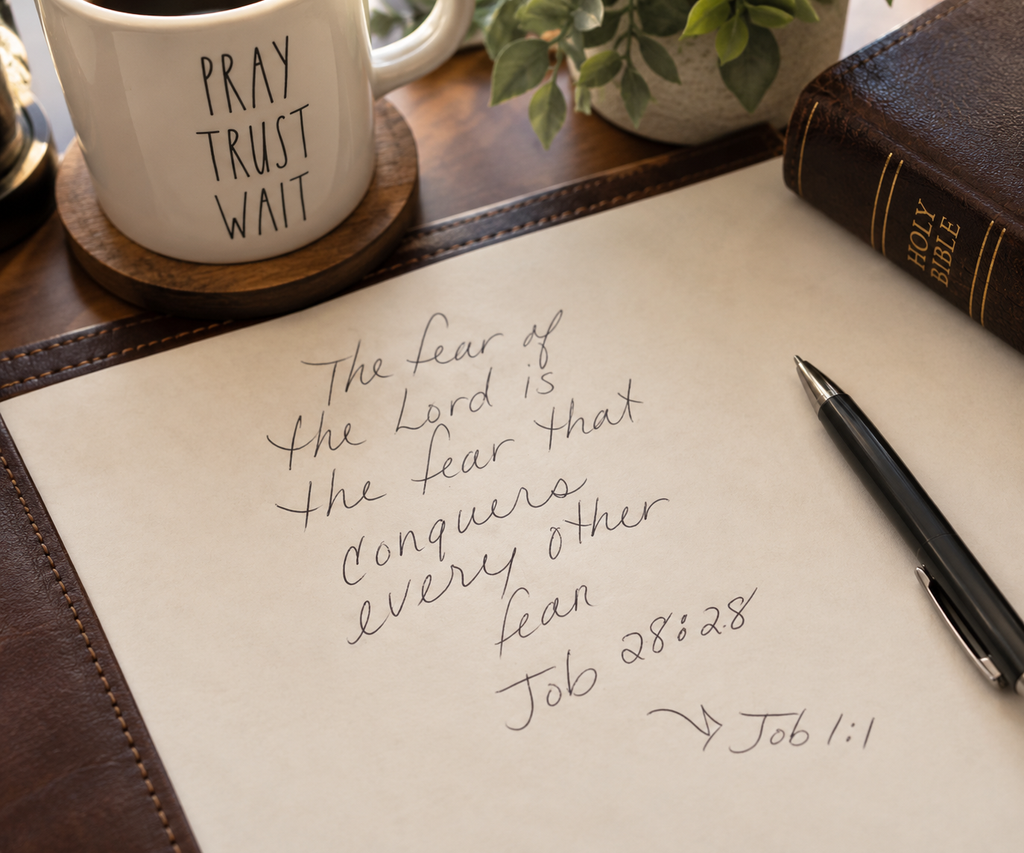
That’s why I wrote “The fear of the Lord is the fear that conquers every other fear” directly onto my desk blotter.
Not necessarily because all my other fears disappear. The diagnosis may still be frightening. The bank account may still be dwindling. The relationship may still be uncertain. Someone I love may still be struggling. Tomorrow may still contain something I don’t want.
The thing I’m afraid of losing may actually be lost.
Job certainly knew something about that.
But none of those things gets to be God.
And We’re Back to Other Gods
I’ve been thinking about all of this while our Women in the Word groups are beginning Kelly Minter’s No Other Gods. And once again, fear and idolatry seem to be bumping into each other.
Sometimes an idol can be exposed by something I love too much.
But sometimes an idol may be exposed by something I fear too much.
What am I desperately afraid of losing? What am I frantically trying to protect? What outcome do I believe I absolutely must prevent? What circumstance am I trying to control? What do I believe I must have in order to be safe, secure, significant, or okay?
And perhaps the most revealing question:
What fear is making decisions for me?
Fear of rejection can determine what I say. Fear of losing someone can turn love into control. Fear of financial insecurity can determine whether I obey God with my resources. Fear of failure can keep me from doing something God has called me to do. Fear of the future can consume today while I try to control tomorrow.
Whatever I fear most can begin to exercise tremendous control over my life.
Which sounds suspiciously like something trying to occupy a place that belongs to God.
What Happens If I Actually Lose It?
That’s where I left us last time.
What if the thing I’m afraid of losing is actually gone?
Job lost the things we spend enormous amounts of energy trying to protect. And yet Job 28 doesn’t ultimately give us an explanation for Job’s suffering.
It gives us something better.
God.
The answer isn’t that Job needs to become stronger than his circumstances, understand everything that has happened, or figure out how to prevent another disaster.
The answer begins here:
“The fear of the Lord, that is wisdom.”
The thing I’m afraid of may actually happen. The thing I treasure may actually be taken away. The storm may actually be bigger than I am.
But it isn’t bigger than God.
My health is not sovereign. Money is not sovereign. Other people’s opinions are not sovereign. The people I love are not sovereign. My plans are not sovereign. My fears are not sovereign.
God is.
So maybe I don’t need to become fearless.
Maybe I need to fear the right One.
Because when God occupies His rightful place, everything else—including the thing I’m afraid of losing—has to move off the throne.