The clock strikes, and once again we find Scrooge restless in his bed—a man wide awake, braced for what’s to come. This time, he’s not about to be caught off guard. With a flick of his wrists, he throws open every curtain around him, determined to challenge the Spirit the moment it arrives.
But then—silence.
The Ghost of Christmas Past appeared right on cue, but the next visitor is nowhere to be seen. Time ticks by. Still nothing… only a faint, ruddy glow flickering from the next room, teasing the edges of Scrooge’s anticipation.
Curious and just a bit impatient, Scrooge slides into his slippers and softly shuffles toward the door. What (or who) awaits him this time? The adventure is far from over—let’s step through that door together.
The Ghost Awaits
Just as God calls each of us by name, the Ghost of Christmas Past calls out to Scrooge, inviting him to enter. Without hesitation, Scrooge obeys.
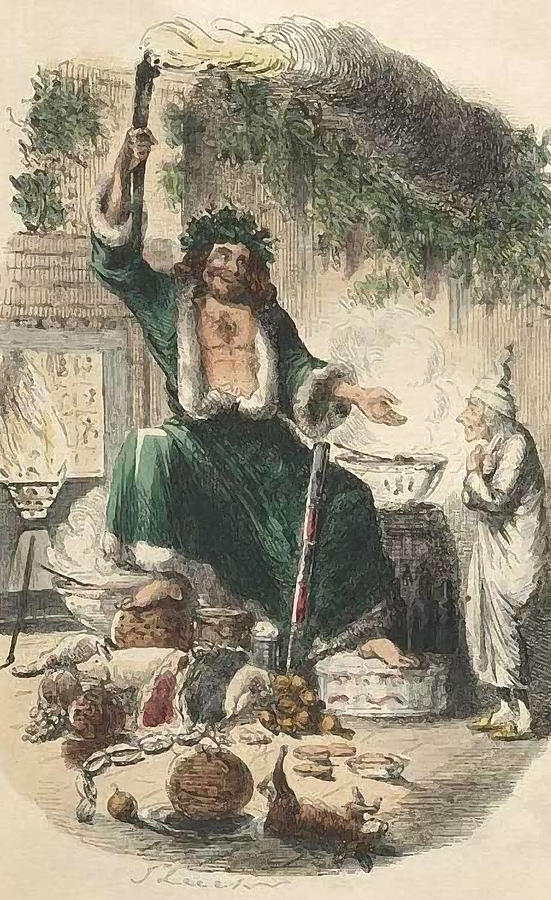
“Come in and know me better, man!”
The scene is truly memorable—Dickens paints it with vivid detail. The Ghost is adorned with a holly wreath upon his head, a powerful Christian symbol: the sharply pointed leaves evoke the crown of thorns, the bright red berries represent Christ’s shed blood, and the deep green stands for eternal life. Around his waist, he wears an antique, rusted scabbard, notably without a sword. This tells us he is not a man of war, but a peaceful figure—mirroring Christ, the Prince of Peace.
At one point, the Ghost asks Scrooge if he has ever met any of his more than eighteen hundred brothers. While Scrooge is baffled, readers understand that, by 1843, over eighteen centuries had passed since the birth of Christ.
Eager for change, Scrooge urges the Ghost to begin their journey immediately. Like the woman seeking healing in Matthew 9:20-22, Scrooge longs for transformation. In response, the Ghost simply says, “Touch my robe!”—and with that, their adventure through Christmas Present begins.
The Torch of Blessing
It’s Christmas morning; it’s also a Sunday morning, and Scrooge is about to learn an important lesson about how to treat his fellow humans. The Ghost moves among the townspeople, sprinkling incense on their food as a blessing. At one point, when two people begin to quarrel, the Ghost gently sheds a few drops of water from his torch onto them, and their cheerful attitudes return.
Scrooge boldly asks the Ghost a question that has been troubling him. Assuming the Ghost represents God, he inquires:
“I wonder you, of all the beings in the many worlds about us, should desire to cramp these people’s opportunities for innocent employment… You would deprive them of their means of dining every seventh day, often the only day on which they can truly dine at all. You seek to close these places on the Seventh Day, and it comes to the same thing… Forgive me if I am wrong. It has been done in your name, or at least in that of your family.”
Through this dialogue, Dickens uses his story to critique aspects of society and the church he finds unfavorable. Mark 2:27 states that the Sabbath was made for man, not man for the Sabbath. However, the church had established the practice of closing businesses on Sundays—the day they chose to represent the Sabbath, following Jewish tradition. In the Ghost’s reply, Dickens highlights the hypocrisy of those who claim to represent Christ but fail to show His love:
“There are some upon this earth of yours who lay claim to know us, and who do their deeds of passion, pride, ill-will, hatred, envy, bigotry, and selfishness in our name, who are as strange to us and all our kith and kin, as if they had never lived. Remember that, and charge their doings on themselves, not us.”
Scrooge promises to remember, and they continue on to Bob Cratchit’s house.
The Cratchit Abode
The Ghost took Scrooge to his clerk’s humble home. Pausing at the threshold, the Spirit paused to bless the dwelling with a gentle sprinkling from his torch.
Each member of the Cratchit family genuinely delights in the presence of the others. They greet each other as if reunited after a long absence, savoring the gift of their present moments together. Their happiness derives not from material possessions or perfect health but from an abiding, reciprocal love—a wonder to Scrooge.
Bob and Tiny Tim arrive home from church. Tiny Tim is joyful at having attended; for the people there, “it might be pleasant to remember upon Christmas Day, who made the lame beggars walk and the blind to see.” (John 5:1-9 and Matthew 8:22-25)
For the first time, Scrooge experiences true concern for another.
“Spirit,” said Scrooge, with a new interest stirring within him, “tell me if Tiny Tim will live.”
“If these shadows remain unaltered by the future, none other of my race,” returned the Ghost, “will find him here. What then? If he be like to die, he had better do it, and decrease the surplus population.”
Colossians 2:17 — These are a shadow of the things that were to come; the reality, however, is found in Christ.
The Ghost now turns Scrooge’s own harsh words back upon him, forcing him to reflect on what, or who, is truly “surplus,” and by whose judgment such a determination is made. Confronted by this challenge, Scrooge is overcome with regret for his past attitudes and words.
The Miners ~ The Lighthouse ~ The Ship
As Scrooge journeys with the Ghost of Christmas Present, Dickens introduces us to isolated groups—the miners deep beneath the earth, men tending a distant lighthouse, and sailors braving the open sea. Though each faces hardship and seclusion, they are all depicted embracing the spirit of Christmas. The warmth of the holiday unites them, offering connection, hope, and solace, even in the most desolate settings.
Through these scenes, Dickens underscores a central theme: the transformative power of Christmas extends to even the most removed corners of the world. Each scene shows a light in the darkness – the Spirit of Christmas that inhabits each one. The joy and fellowship of the season transcend isolation, linking all people in a shared sense of comfort, community, and celebration, regardless of physical distance or circumstance.
Scrooge was incredibly surprised to observe that, despite their lack of material wealth, the people around him possessed an undeniable delight in the day, going about their Christmas festivities with not a care in the world—at least not at this very moment. This realization struck him deeply, as he witnessed pure joy existing even amidst humble circumstances. Suddenly, Scrooge heard a familiar laugh that caught his attention—a joyful, hearty sound that he immediately recognized as belonging to his nephew, Fred.
Fred’s Home
As Scrooge watched from a distance, he realized that his own refusal to participate in their Christmas celebration was, in truth, his loss. The warm camaraderie and genuine happiness shared among Fred, his friends, and family was undeniable. Scrooge could see that their laughter and togetherness were expressions of the joy of the Lord at Christmas, enriching their spirits in ways that riches never could.
During the celebration, Scrooge’s grand-niece played a tune on the piano—a melody that struck a chord in his memory, for it was the very same song his beloved sister used to play so many years ago. This music, gentle and familiar, served as a powerful reminder of the past. All the things that the Ghost had shown him throughout the night came flooding back into his mind; he found himself growing softer and more open with each memory and every note that was played, his old hardness melting away.
By the end of the scene, a profound happiness washed over Scrooge. He was so moved by the warmth, laughter, and love in Fred’s home that he longed to remain there longer, cherishing the newfound sense of belonging and joy that he had so often denied himself.
Final Travels
The Ghost of Christmas Present continued his School of Charity for Scrooge, leading him through every hospital, almshouse, poor home, and jail in the city. With each visit, the Spirit demonstrated to Scrooge how deeply he is called to care for others during his lifetime on earth. Scrooge is challenged to live out the teachings of Matthew 25, to tend to the needs of the most vulnerable around him.
Together, they spent what felt like a long and extraordinary night, living through the experiences of all 12 Days of Christmas compressed into a single evening. As they journeyed together, Scrooge noticed with a sense of sorrow that the Ghost’s once chestnut hair gradually turned grey—a sign that every Christmas is allotted only a single day, and, once this present Christmas ends, it is gone forever. The message was clear: life is fleeting, and each moment to do good cannot be reclaimed once it has passed.
In a sudden and haunting moment, Scrooge glimpsed beneath the Spirit’s robe and saw two emaciated children, spectral in their frailty—one representing Ignorance, the other Want. These were not ordinary children; they were the offspring of all humanity, embodiments of society’s neglect. The Spirit warned that unless changes are made, these children’s fates would be sealed by Doom.
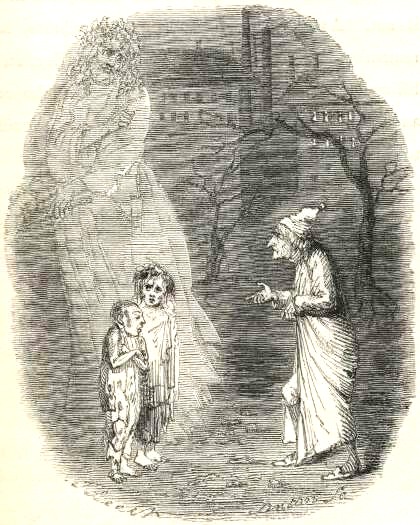
“Are there no prisons?” replied the Spirit, fixing Scrooge with a grave look and repeating the miser’s own callous words back to him. “Are there no workhouses?”
“Have they no refuge or resource?” cried Scrooge in alarm.
This Spirit disappeared, and just as the bell sounded midnight, the ominous figure of the Ghost of Christmas Yet to Come began to move silently toward Scrooge, marking the next leg of his journey.