The Physical Before the Cognitive
I convinced hundreds of students that I was allergic to paper from spiral notebooks.
I had a speech. I gave it every year. I even gave it at Back-to-School Night so the parents heard it, too: No spiral notebooks in my classroom. For anything. Ever.
When you collect thousands of sheets of paper, you develop opinions about paper. I wanted the papers I collected to be the same size, to stack neatly, and—most importantly—not to have those frayed, nasty edges left behind when someone ripped a sheet out of a spiral notebook.
And no, the perforated kind didn’t solve the problem. Tear along the perforation and you were left with a weirdly sized sheet of paper that didn’t line up with classic loose-leaf notebook paper.
I had standards.
I also had a student supply area in my classroom stocked with loose-leaf paper for anyone who didn’t bring it. If I was going to require something, I was going to make sure every student had access to it.
Still, inevitably, someone would bring a spiral notebook. And eventually someone would rip out a sheet of paper and attempt to turn in an assignment on it.
That’s when things got dramatic.
Spiral paper was remarkably easy to spot in a stack. I would extract the offending sheet, hold it as far away from my body as possible between two pinched fingers, and exclaim, “Somebody take this! Ahhh!”
Yes, I made it big. Yes, I made it ridiculous.
The culprit would retrieve the foul paper and cut off the schnervals—the ragged little pieces left clinging to the edge—then deliver the entire strip of those nasty little buggers directly to the trash, accompanied by a promise never to do such a thing again. Meanwhile, the rest of the class waited to see if I was going to break out in hives.
Apparently, I was more convincing than I realized.
One day I overheard two young ladies talking.
“Did you know she’s allergic to spiral paper?” one said. “How does that even happen?”
The second girl looked at her. “You know she’s kidding, right?”
“What? Really?”
The second girl rolled her eyes and looked up at me. I just smiled and shook my head.
It worked.
There Was a Method to the Ridiculousness
I wasn’t really allergic to spiral paper. (Just in case you fell for it too!) I was establishing a pattern.
I’ve always believed that before I can ask students to do the hard work of thinking, I need to eliminate as much unnecessary thinking as I can.
The physical before the cognitive.
Students need to know where to put things, what they need, what they’re supposed to do when they enter the room, and how class begins. Those are questions that need answers, but once they’ve been answered, I don’t want students answering them again every day.
I want their brains available for better questions: Why did the character make that choice? What evidence supports that interpretation? Why did the author use that word? Can you defend your conclusion?
The physical things—the materials, movement, procedures, and routines—should eventually fade into the background so the cognitive work can move to the foreground.
The Humble Composition Book
My warm-up procedure was probably the best example of this.
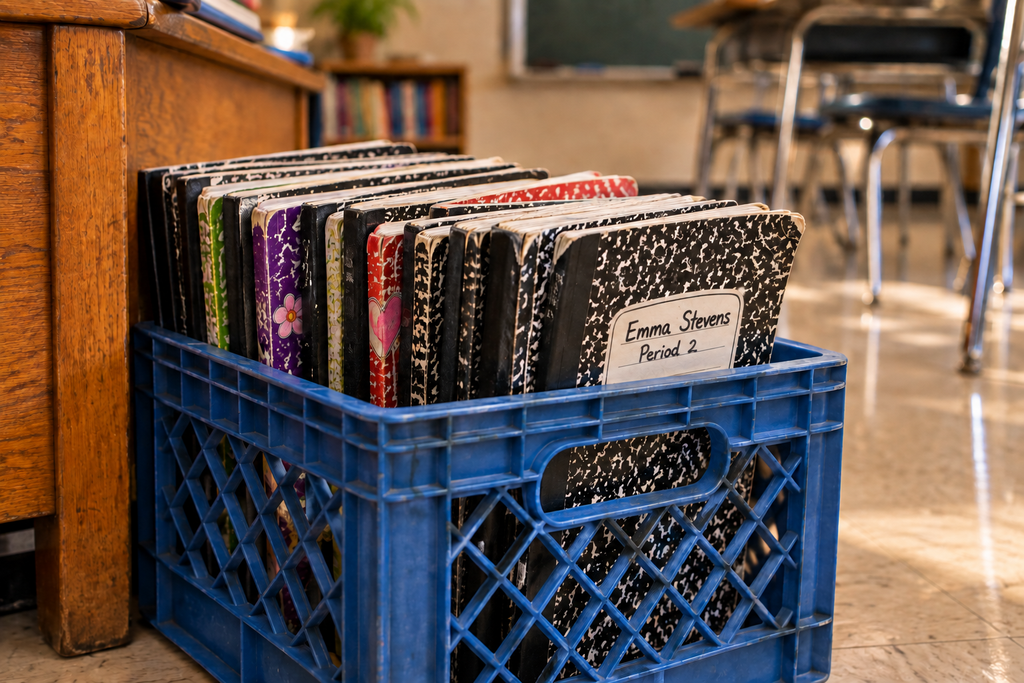
Every student had a traditional black-and-white, seam-bound composition book. Same kind. Same size. They could decorate the cover however they wanted, and they could even purchase one in another color. But it had to be the same kind and size.
No spirals.
There was a practical reason for that, too. Composition books fit beautifully into old milk crates. Each class had its own milk crate—and, of course, each crate was a different color.
And yes, every year somebody brought the wrong notebook. Usually a spiral. So, I kept extra composition books. I wasn’t interested in turning the wrong notebook into a crisis; I wanted the system to work. If students didn’t have the right book, I simply gave them one.
Once we established the routine, students knew exactly what happened when they entered my room. They got their composition books, had a seat, and began the warm-up already waiting on the board. Some classes had students who regularly arrived early and volunteered to take the books out of the crate and place them on everyone’s desks.
Every warm-up entry included the day, date, and assignment. If a student had been absent, there was no warm-up to make up. The student simply wrote ABSENT for that day, and those points weren’t counted against the grade. And yes, I checked my attendance records.
When warm-up time was over, we went over the assignment together so students could correct any errors. Then the books were collected, returned to the crate, and we continued with class.
It became automatic. Students didn’t have to wonder how class was going to begin, and neither did I.
We just began.
And Yes, I Graded Them
The composition books never had to leave my classroom. They weren’t carried around in backpacks, left at home, or forgotten in lockers. They lived in their milk crates, right where we needed them every day.
And I graded every book. Students earned points for completing all parts of the warm-up and following the procedure, including the day and date. I often left little notes or stickers throughout—not only as evidence that I had actually read their work, but because the students loved finding them when they got their books back. After the final warm-up of the marking period, I recorded the student’s percentage right there in the book and then entered it in my gradebook.
Yes, it took time. A lot of time. But I was determined to follow through on what I had asked of them. So during the last week of the marking period, you could find me after school at my desk with stacks of composition books, the lighting just right, good music playing, and a cup of coffee beside me.
Then I got to it and got it done.
Every. Marking. Period.
Occasionally, a parent would question a low warm-up grade, and I would agree with them. A low grade on the warm-ups was ridiculous.
Students didn’t have to get every answer right the first time. We went over the warm-ups together, and they could correct errors. If they were absent, the missed points didn’t count against them. They simply had to do the work. If it wasn’t done, that was a choice the student had made.
And yes, they lost points for leaving out the day or date.
That wasn’t because I was looking for tiny reasons to deduct points. Following the procedure taught responsibility, and it made the system work. When I sat down with an entire marking period’s worth of entries, I needed to see quickly what had been completed, what had been missed because of an absence, and whether all parts of the assignment were there.
Good procedures should work for everyone in the classroom. Students learned to take responsibility for organizing and completing their work, and their teacher could score a milk crate full of composition books without losing her mind.
Both of those things mattered.
Consistency Goes Both Ways
Inspect what you expect.
If I told students the warm-ups mattered but never looked at them, it wouldn’t take long for them to conclude that they didn’t really matter. And if I established a procedure in August and ignored it by October, I couldn’t be terribly surprised when my students ignored it, too.
Procedures don’t maintain themselves. We teach them, practice them, reinforce them, and, when necessary, teach them again.
But that consistency isn’t only the students’ responsibility. It’s ours.
If I expect students to follow the system I’ve established, I have a responsibility to make sure the system has a purpose, that students have what they need to follow it, and that I follow through on my part of it—even when my part means spending the last week of every marking period after school with a very large stack of composition books.
Sometimes You Go Back Into the Hallway
Some of the best teachers I have ever known practiced this principle.
One day, I heard some commotion outside my classroom. I was mid-sentence, but I had half a second to take half a step into the English hallway and see what was happening.
A couple of doors down stood one of my colleagues—with her entire class.
Apparently, they had not entered her classroom correctly, so she had taken them back out. There they stood while she reminded them of the proper way to enter her room. They were going to review it and practice it so they would be able to get it right tomorrow.
I smiled to myself, took my half step back into my own classroom, and continued my lesson.
I knew exactly what she was doing.
She wasn’t wasting instructional time. She was protecting it.
A few minutes spent reteaching a procedure could prevent countless minutes of correction, redirection, and frustration later. More importantly, those students were learning how to function independently in that classroom. She wouldn’t always need to tell them what to do.
Eventually, they would just know.
Order Makes Room for Learning
My classroom was neat. Very neat.
It was clean, organized, and attractive, and that was intentional. I couldn’t expect students to organize their materials, follow established procedures, put things where they belonged, and take care with their work while modeling disorder from the front of the room.
You cannot teach orderliness without modeling it.
That didn’t mean students weren’t allowed to use the room. It was a classroom, not a museum. We made things, moved things, and worked. But things had places, and when we were finished, things went back where they belonged.
The physical environment was teaching something, too: we take care of this space, we take care of our materials, and we take care with our work.
But the order wasn’t the point.
The order made room for the point: learning.
There is some actual pedagogy underneath all of this. Cognitive-load theory gives a name to something good teachers often discover through experience: working memory is limited. Students can consciously manage only so much information at once.
Every unnecessary decision asks for a little piece of that capacity. Where do I sit? What do I get out? What am I supposed to be doing? What happens next? None of those questions is particularly difficult. That’s precisely why I don’t want students spending much mental energy on them. Bloom’s taxonomy reminds us where we actually want that energy going. We want students moving toward more complex thinking—applying, analyzing, evaluating, creating.
I don’t want students using part of their mental capacity figuring out what Dr. Peterson wants them to do with their papers while I’m asking them to consider whether Romeo and Juliet’s tragedy is caused more by the choices they make or by the world the adults have created for them.
Take care of the first one.
Make the routine routine.
Then use that mental energy for Romeo and Juliet.
Don’t Be in Such a Hurry to Start Teaching
The beginning of a school year comes with enormous pressure to get started. There are standards to cover, curriculum maps to follow, pacing guides staring accusingly from somewhere on your desk, and testing dates already on the calendar.
It can feel irresponsible to spend precious instructional time teaching students how to enter the room, how class begins, where materials belong, or what kind of notebook to use.
It isn’t.
You are teaching.
You’re teaching responsibility and independence. You’re teaching students how learning is going to happen in this space. Take the time to teach the procedure. Explain why it exists when that explanation helps. Provide what students need to succeed within it. Practice it, model it, and follow through. And if February comes and the procedure has fallen apart, take everybody back into the hallway and teach it again.
Not because compliance is the goal.
Learning is the goal.
Order makes room for it. The physical becomes familiar, the procedural becomes automatic, and students take greater responsibility for themselves. All those little decisions begin to disappear into the background, leaving more room for the kind of thinking that really matters.
And if, somewhere along the way, you need to convince a few generations of students that their English teacher suffers from a rare and potentially dangerous allergy to spiral notebook paper?
Well.
It works.