Charles Dickens’s A Christmas Carol (ACC) has a way of sticking with me throughout the year. I often find myself quoting lines from the text in everyday conversations, only to be met with confused looks or have my references completely ignored.
This year, I had the unique privilege of teaching ACC to the regulars in my Ladies’ Bible Study sessions. It was a joy to delve into the language, to explore its themes, and to share the profound ways God’s Word weaves through the story.
I’d love for you to join me on this journey as I share my thoughts with you in this series of blog posts!
A Christmas Carol of Redemption
A Christmas Carol is a timeless literary classic, acclaimed for its profound insights into life and the human condition, delivered with masterful artistry. Its enduring appeal lies in universal themes that transcend time, place, and custom, resonating with readers as powerfully today as when first published.
Written in 1843, Dickens composed the story to address London’s neglected poor and inspire generosity and kindness, especially during Christmas. The novella quickly became a bestseller and remains among his most cherished works.
More than a novelist, Dickens was considered to be a moral teacher, deeply influenced by Christian values of compassion and redemption and shaped by personal hardship. His spiritual convictions, especially the teachings of Jesus, defined both his life and writing.
Studying A Christmas Carol means exploring Dickens’s belief in the potential for personal and societal transformation, and recognizing generosity, love, and redemption as central to the human story.
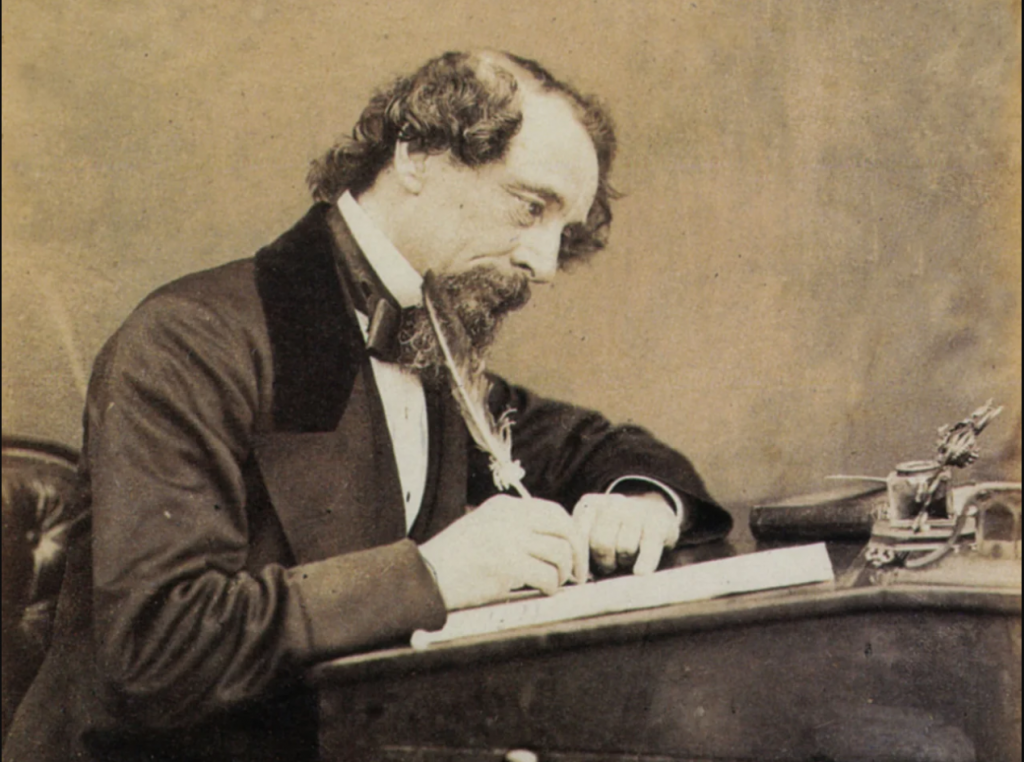
Acclaimed Author of A Christmas Carol
Charles Dickens (1812–1870), a leading Victorian-era writer from Portsmouth, England, faced early hardship when his family’s financial woes forced him to work in a factory at age 12, shaping his empathy for the poor. He married Catherine Hogarth in 1836, with whom he had ten children; their marriage deteriorated over time, and in 1858, after 22 years, they separated—a scandal in Victorian society. In 1857, Dickens began a secret relationship with 18-year-old actress Ellen Ternan, likely lasting until his death. He also formed a close bond with Catherine’s younger sister, Mary Hogarth, whose early death profoundly affected him and influenced many of his literary characters.
Analysis of A Christmas Carol
As with any literary study, our analysis will focus on the various lenses through which we interpret a text. Common approaches include historical, biographical, sociological, archetypal, and philosophical perspectives. For this exploration, we’ll be using two lenses: the rhetorical (also known as formalist or New Criticism) and the Scriptural.
The rhetorical lens invites us to delve into the text’s own beauty—its themes, motifs, characters, and narrative structure—spotlighting the artistry and craft of the author. The Scriptural lens, on the other hand, guides us to seek out and highlight biblical ideas, themes, and echoes of Bible passages found throughout the work.
Rather than spending time on Dickens’s life as reflected in the novel (biographical), the influence of the era on the story (historical), or the ways in which class and society shape the narrative (sociological), our focus will remain on the text itself—its rhetorical craft—and the integration of Scripture woven throughout.
A Christmas Carol Organization
Although we often use the term carol to refer to any song associated with the Christmas season, Dickens employs the term in its traditional sense: a song celebrating the birth of Jesus Christ. In this context, each section of the text is labeled as a STAVE, signifying a stanza of this Christmas carol.
Narration of A Christmas Carol
Dickens tells the story through a third person limited narrator focused on Ebenezer Scrooge. This means the narrator observes from outside the story, but shares Scrooge’s thoughts and experiences, revealing only what Scrooge knows or encounters. We understand other characters chiefly through their interactions with Scrooge, not their private thoughts. Occasionally, the narrator addresses the reader directly for humor or insight. This narrative style allows us to experience Scrooge’s emotions and transformation firsthand, keeping us closely connected to his journey without being distracted by the inner worlds of other characters.
A Christmas Carol Invitation
As we embark on this journey through Charles Dickens’s A Christmas Carol, may we open our hearts to its timeless themes of hope, redemption, and transformation. Dickens’s classic does more than introduce us to the unforgettable Ebenezer Scrooge—it gently prompts us to reflect on our own lives and the ever-present possibility of renewal. These are truths that echo deeply within the heart of the Gospel.
In the next post, we’ll delve into the Preface and Stave I, discovering how Dickens sets the stage for a story where even the bleakest winter in Victorian London is pierced by the warmth of generosity and grace. I invite you to join me as we explore how light can enter even the coldest of hearts and how the message of Christmas can renew us all.
Let us journey together, inspired by these encouraging words from Scripture:
“Therefore, if anyone is in Christ, he is a new creation. The old has passed away; behold, the new has come.”(2 Corinthians 5:17)
I look forward to sharing this adventure with you, and I warmly encourage you to join me for our next reflection as we begin to walk the pages of Dickens’s beloved tale.
Coming Soon: A Christmas Carol ~ Preface and Stave I


Thank you for sharing. i wasn’t able to attend because i had a new grandson. i plan on sharing this with my husband too. God Bless you and your family during this season and i’m forever grateful for everything you share with us on Fridays. Merry Christmas and God Bless You.
sabrina
Thank you, Sabrina!