Welcome, dear readers, to the sixth and final episode in our blog series on A Christmas Carol. As we journey together to the conclusion of this timeless tale, let’s reflect on the lessons and spirits we’ve encountered. Now, let’s turn to the next pivotal moment in Scrooge’s story:
Stave IV
The Last of the Spirits approached Scrooge. It was “shrouded in a deep black garment, which concealed its head, its face, its form, and left nothing of it visible save one outstretched hand.”
Just as in our own lives, the future arrives long before we are prepared for it. It often sneaks up on us, catching us unaware.
Scrooge is ready in theory, but he is not prepared for a silent Spirit who fills him with dread. He wants to learn what the Spirit has to teach, yet he nervously wishes the ordeal would pass quickly.
“Ghost of the Future!” he exclaimed, “I fear you more than any spectre I have seen. But as I know your purpose is to do me good, and as I hope to live to be another man from what I was, I am prepared to bear you company, and do it with a thankful heart. Will you not speak to me?… Lead on!”
The Royal Exchange
Scrooge recognizes the place—he does business there daily—but cannot see himself. He overhears a conversation about a funeral, never suspecting that he is the subject of their casual indifference.
“Scrooge was at first inclined to be surprised that the Spirit should attach importance to conversations apparently so trivial; but feeling assured that they must have some hidden purpose, he set himself to consider what it was likely to be… But nothing doubting that to whomsoever they applied they had some latent moral for his own improvement, he resolved to treasure up every word he heard…”
He treasures up every word—absorbing it all, though he does not yet understand. This response closely mirrors that of Mary, the mother of Jesus, when the shepherds reported the angelic announcement of Jesus’s birth: she “treasured up all these things and pondered them in her heart” (Luke 2:19). Sometimes we must hold these moments until they make sense.
Still, Scrooge is surprised not to see himself in these scenes as he had before with the Spirits of the Past and Present. He hopes optimistically that he is absent because he is elsewhere, engaged in good works.
“He looked about in that very place for his own image… he saw no likeness of himself among the multitudes that poured in… it gave him little surprise, however; for he had been revolving in his mind a change of life, and thought and hoped he saw his new-born resolutions carried out in this.”
However, though Scrooge’s thoughts have begun to shift, his heart and actions have not yet fully followed. As James writes: “As the body without the spirit is dead, so faith without deeds is dead.” (James 2:26)
Three Unwise Thieves
The Charwoman, the Laundress, and the Undertaker’s man approach Joe, the pawnbroker, to sell the personal effects of a dead man.
The Laundress even sells the shirt taken from the deceased’s very body. Scrooge is appalled:
“Scrooge listened to this dialogue in horror… he viewed them with a detestation and disgust.”
This scene parallels the prophet Nathan confronting David using a parable in 2 Samuel 12:1–7. Nathan’s story awakens David’s conscience, leading to repentance. Here, the Ghost similarly exposes Scrooge to his own condition.
The Corpse
Scrooge next finds himself in the bedroom of the deceased. The Spirit beckons him to draw back the sheet and look upon the man’s face, but he refuses. He is coming to grasp that while death kills the body, the soul and spirit have eternal weight. Yet, he cannot bring himself to see.
The Couple
Scrooge requests to see someone who feels emotion at this man’s death. The Spirit shows him a couple, not grieving, but relieved—the death has granted them a reprieve from a crushing debt. Their gratitude is for time, not loss.
The Cratchits
This is not the tenderness Scrooge sought. He asks to witness “tenderness connected with a death.” The Spirit brings him to the Cratchit home, now eerily still. The children gather quietly as Peter reads from Scripture:
“And he took a child, and set him in the midst of them.”
Dickens quotes Mark 9:36, trusting that contemporary readers would recite the rest from memory:
Mark 9:36-37 (KJV) 36 And he took a child, and set him in the midst of them: and when he had taken him in his arms, [Jesus] said unto them, 37 Whosoever shall receive one of such children in my name, receiveth me: and whosoever shall receive me, receiveth not me, but him that sent me.
And again, from Matthew:
Matthew 18:1–5 (NIV) 1 At that time the disciples came to Jesus and asked, “Who, then, is the greatest in the kingdom of heaven?” 2 He called a little child to him, and placed the child among them. 3 And he said: “Truly I tell you, unless you change and become like little children, you will never enter the kingdom of heaven. 4 Therefore, whoever takes the lowly position of this child is the greatest in the kingdom of heaven. 5 And whoever welcomes one such child in my name welcomes me.”
Tiny Tim has recently died. His body lies in the next room. The Cratchit family, united in grief, pledge to honor his memory by living with the kindness and love he always showed.
Scrooge is devastated by Tiny Tim’s death. He now must know the identity of the dead man.
The Churchyard
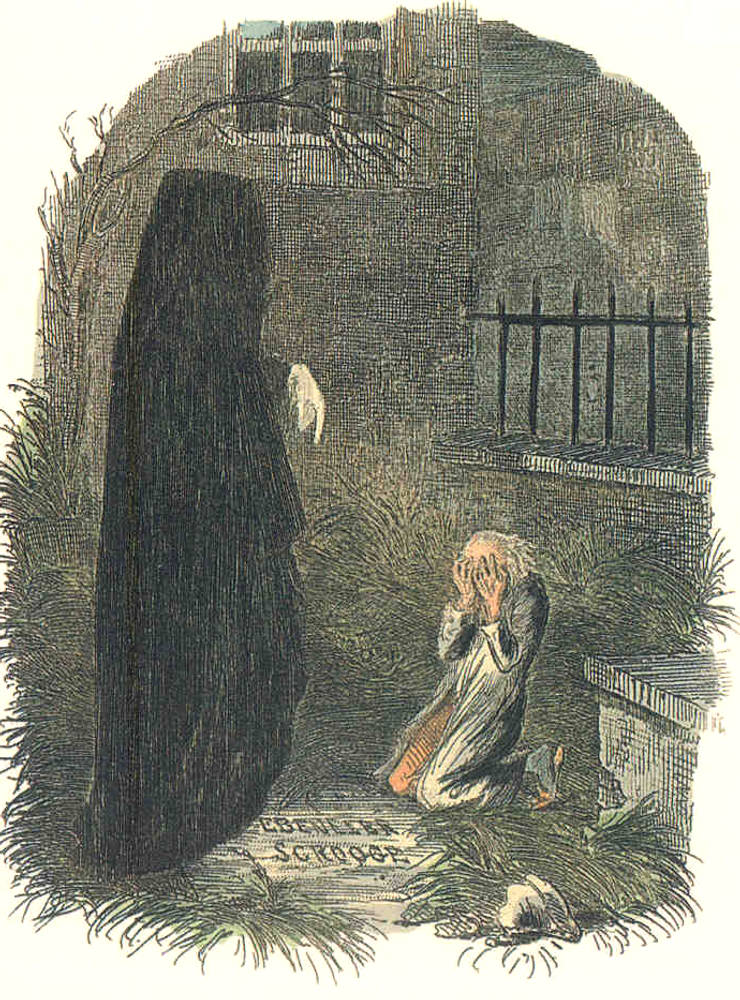
The Spirit brings him to the churchyard. Scrooge is led to a neglected gravestone:
EBENEZER SCROOGE
His own death confronts him at last. Overwhelmed, he begs the Spirit:
Good spirit, your nature intercedes for me, and pities me. Assure me that I yet may change these shadows you have shown me by an altered life.
Here Dickens’s narrative echoes Romans 8:26-27:
“…the Spirit helps us in our weakness. We do not know what we ought to pray for, but the Spirit himself intercedes for us through wordless groans. And he who searches our hearts knows the mind of the Spirit, because the Spirit intercedes for God’s people in accordance with the will of God.”
Scrooge makes his own vow:
“I will honour Christmas in my heart, and try to keep it all the year. I will live in the Past, the Present, and the Future. The Spirits of all Three shall strive within me. I will not shut out the lessons that they teach. Oh, tell me that I may sponge away the writing on this stone!”
He wrestles with the Spirit as Jacob did with God in Genesis 32—emerging not untouched, but transformed, with a newfound blessing.
Stave V
It’s Christmas Day, and Scrooge has become like the little child described in Matthew 18. Time now rings with happy bells, and he is ready to dive into his new life.
He sends a turkey to the Cratchit family, then gets ready for the day—though he finds it difficult to shave while chuckling and dancing! He goes to church, interacts warmly with people, pays close attention, and enjoys everything with a newfound joy.
Though he doesn’t mind the general public gawking and making fun of his unusual giddiness on this new day, he is a bit apprehensive about going to Fred’s house.
“He passed the door a dozen times before he had the courage to go up and knock. But he made a dash and did it…”
Our family is always the hardest to convince of a change in our character. They know us truly, and they are often the most skeptical—so Scrooge is understandably wary of how he’ll be received. He is overjoyed to find that his nephew, family, and friends welcome him with open arms.
The next day, Scrooge surprises Bob Cratchit with a significant raise and the kindness Bob and his family, especially Tiny Tim so deeply need. Scrooge learns at last to keep Christmas well; this, truly, is the secret to joy in life. Christ gives meaning to all time, and His birth should be joyously celebrated by all.
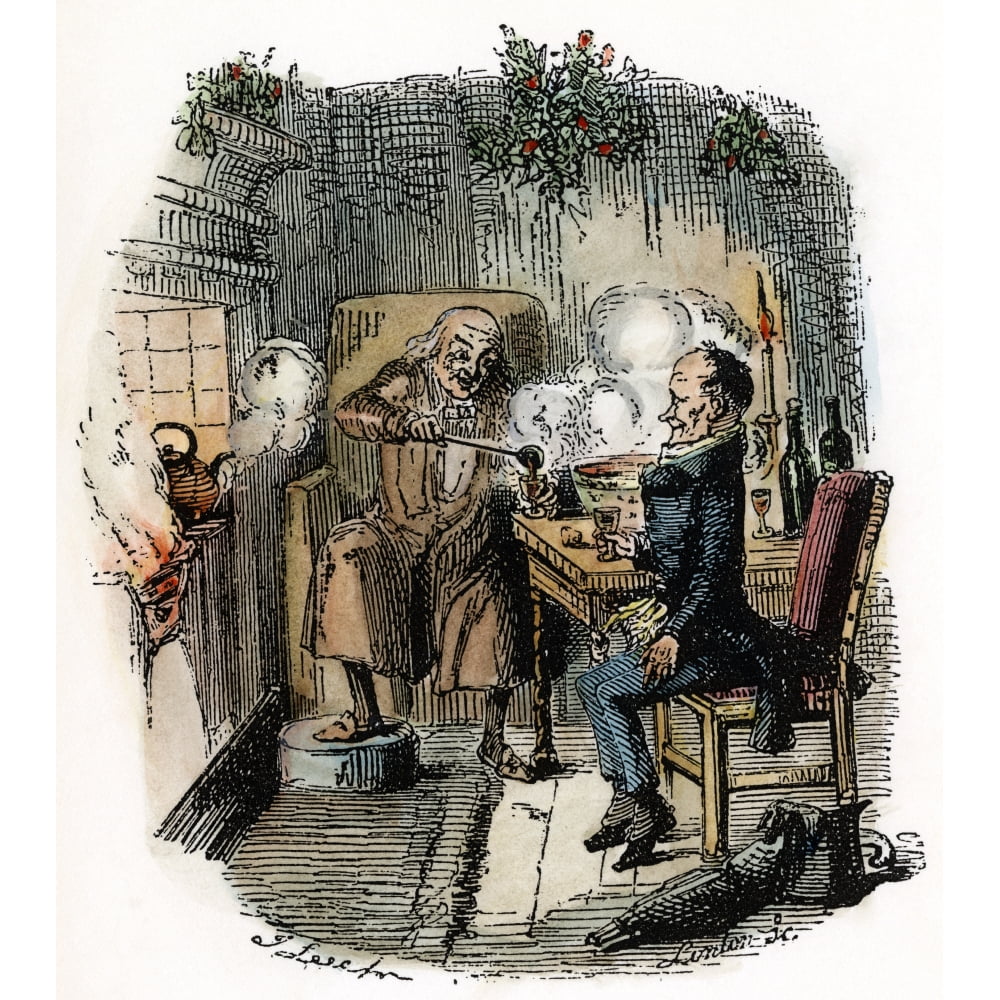
“Scrooge was better than his word. He did it all, and infinitely more; and to Tiny Tim, who did NOT die, he was a second father. He became as good a friend, as good a master, and as good a man, as the good old city knew, or any other good old city, town, or borough, in the good old world.”
Christmas gives us TIME, and with LOVE the finite becomes infinite.
Charles Dickens kept Christmas for himself, for his children, for his readers, and for all of us.
May God bless us, Every One.