Stave I
Once upon a time…
Dickens opens with a classic fairy-tale phrase, making it clear to the reader that this is a work of fiction—a story meant to transcend specific times or places. By employing this familiar introduction, he signals that the events could belong to any era, grounding the narrative in universality.
He establishes the mood through vivid descriptions of the weather: cold, bleak, biting. Despite it being only three o’clock in the afternoon, darkness has already settled—in fact, it has not brightened all day. Dickens skillfully layers imagery of light and darkness with that of the merciless weather to immerse the reader in the story’s somber atmosphere.
“…one might have thought that Nature lived hard by and was brewing on a large scale.”
Here, Nature is personified in keeping with Victorian conventions. Dickens suggests that Nature itself resides nearby, preparing for something momentous, hinting that significant change is imminent.
Scrooge and Fred
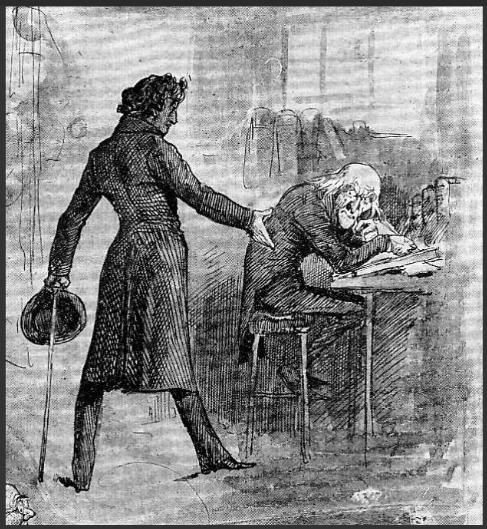
With the oppressive gloom of Scrooge’s office firmly established—Bob Cratchit attempting to warm himself by a feeble candle—Dickens introduces Fred. Fred’s entrance is abrupt and energetic; he brings with him the light and warmth of Christmas cheer, sharply contrasting with the chill and darkness surrounding Scrooge. This juxtaposition reinforces the theme of hope and transformation central to the narrative, preparing the stage for the unfolding story.
“A merry Christmas, uncle! God Save you!”
“Bah!” said Scrooge, “Humbug!”
They go on to banter about how Scrooge should be merry since he is rich, and Fred should be dismal because he is poor. Yet, the reality is quite the opposite. Scrooge continues by sharing his opinion on what he considers a wasted day of the year—when people spend more than they should, gain no real benefit, and yet somehow remain happy about it.
Fred, however, responds eloquently, offering the meaning of Christmas that Dickens wishes his readers to understand. He states that he has always viewed Christmas as a good time, assuming everyone agrees it should be respected because it marks the Birth of our Savior, Jesus Christ:
“But I am sure I have always thought of Christmas time, when it has come round—apart from the veneration due to its sacred name and origin, if anything belonging to it can be apart from that—as a good time; a kind, forgiving, charitable, pleasant time…”
Fred goes on to describe how, during Christmas, people become more aware of each other:
“…the only time I know of, in the long calendar of the year, when men and women seem by one consent to open their shut-up hearts freely, and to think of people below them as if they really were fellow passengers to the grave, and not another race of creatures bound on other journeys…”
He emphasizes how Christmas is a day without social classes or separate groups, a time of unity and compassion.
Concluding his speech, Fred proclaims:
“And therefore, uncle, though it has never put a scrap of gold or silver in my pocket, I believe it has done me good and will do me good; and I say, God bless it!”
Through this declaration, Fred expresses that he keeps and honors Christmas in the past, the present, and the future.
Charitable Donations
During the scene with the gentlemen collecting donations for the poor, Scrooge explains his lack of charity by uttering some well-known statements that are used against him later in the story:
“Are there no prisons?… And the Union workhouses – Are they still in operation?”
“I don’t make merry myself at Christmas, and I can’t afford to make idle people merry. I help to support the establishments I have mentioned – they cost enough; and those who are badly off must go there.”
“Many can’t go there; and many would rather die.”
“If they would rather die,” said Scrooge, “they had better do it, and decrease the surplus population.”
With these harsh words, Scrooge dismisses the gentlemen, making it clear he has no interest in charitable giving. As they leave, the atmosphere remains cold and unwelcoming. Almost immediately afterwards, a young lad approaches Scrooge’s door, cheerfully singing a Christmas carol in hopes of earning a small token of kindness. Scrooge, in no mood for festive cheer, grabs a ruler and threatens to throw it at the child, forcing him to run away in terror.
Still grumbling after these encounters, Scrooge turns his attention to his clerk, Bob Cratchit, who timidly asks for all of Christmas Day as a holiday. Scrooge reacts irritably, treating the request as if Bob were attempting to steal from the business, begrudgingly granting the day off but making his displeasure clear and requiring him to start the next day earlier than normal.
Home Sweet Home
Scrooge had his melancholy dinner in his usually melancholy tavern and then headed home. The weather remained dismal, with the fog so thick and dark that Scrooge could hardly see his building.
“The fog and frost so hung about the black old gateway of the house, that it seemed as if the Genius of the Weather sat in mournful meditation on the threshold.”
Once again, personified Nature appears—this time lingering on the stoop of Scrooge’s building, as though intent on creating an atmosphere well-suited for a ghostly visit.
As Scrooge approaches his door, he sees Marley’s face in the doorknocker. Although he tries to dismiss the vision, curiosity compels him to check the other side of the door, half-expecting to find the back of Marley’s head there.
Darkness is cheap, and Scrooge liked it.
The darkness seemed to conspire with his imagination, for it encouraged Scrooge to envision a locomotive hearse gliding ahead of him as he made his way to his rooms.
Understandably shaken by this eerie sight, Scrooge carefully inspected every corner of his quarters to make certain that nobody else lurked within. Only after satisfying himself that he was truly alone did he double-lock the door.
As he settled in, a lone bell began to ring, ominously heralding the arrival of a visitor. Soon, the sound swelled as every bell in the house joined in, their clamor filling the air until, all at once, they fell silent. In that sudden hush, Scrooge heard the approach of a Ghost whom Scrooge immediately recognized as Jacob Marley.
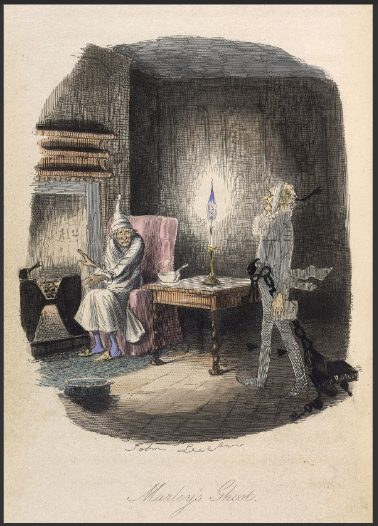
Marley’s Ghost
Dickens describes the Ghost of Jacob Marley, wrapped in chains and weighed down by cashboxes, keys, padlocks, ledgers, deeds, and heavy purses—all symbols of his earthly burdens.
His haunting appearance is vividly rendered:
“His body was transparent; so that Scrooge, observing him, and looking through his waistcoat, could see the two buttons on his coat behind.
“Scrooge had often heard it said that Marley had no bowels, but he had never believed it until now.”
In the mid-1800s, the term “bowels” was understood as the seat of mercy, compassion, pity, and tenderness. The claim that “Marley had no bowels” did not refer to anatomy, but expressed that Marley lacked mercy and compassion, showing pity to no one.
This meaning is evident in Biblical scripture. For example, in Colossians 3:12, the King James Version states:
(KJV) “Put on therefore, as the elect of God, holy and beloved, bowels of mercies, kindness, humbleness of mind, meekness, longsuffering.”
In more modern language, the New International Version translates this as:
(NIV) “Therefore, as God’s chosen people, holy and dearly loved, clothe yourselves with compassion, kindness, humility, gentleness and patience.”
Similarly, in Song of Solomon 5:4,
(KJV) “My beloved put in his hand by the hole of the door, and my bowels were moved for him,”
the NIV adapts this to:
(NIV) “My beloved thrust his hand through the latch-opening; my heart began to pound for him.”
These passages highlight the shift in meaning and deepen the understanding of Dickens’s use of “bowels” to underscore Marley’s emotional void.
Marley’s Purpose
As the encounter unfolds, Marley explains to an incredulous Scrooge that his visitation is for Scrooge’s benefit; echoing sentiments previously expressed by Scrooge’s nephew, Marley insists on the moral responsibility to care for others:
“It is required of every man that the spirit within him should walk abroad among his fellowmen, and travel far and wide; and if that spirit goes not forth in life, it is condemned to do so after death.”
Marley’s chains, then, are the result of his selfish living and serve as a warning to Scrooge, for he too has been forging his own burden in the seven years since Marley’s death. Since his passing, Marley has known no rest or peace, only “incessant torture of remorse.” His regret is clear: he laments the opportunities he missed to do good.
“At this time of the rolling year, I suffer most. Why did I walk through crowds of fellow-beings with my eyes turned down and never raise them to that blessed Star which led the Wise Men to a poor abode! Were there no poor homes to which its light would have conducted me!”
Failing to follow Christ and act with compassion in life, Marley now seeks to inspire Scrooge to change before it is too late. The supernatural nature of this visit also intrigues Marley, who reflects on Scrooge’s sudden ability to perceive him:
“How is it that I appear before you in a shape that you can see, I may not tell. I have sat invisible beside you many and many a day.”
This night, then, marks a special occasion—something unique is unfolding. The extraordinary encounter signals a pivotal moment for Scrooge, linking Marley’s past misdeeds to Scrooge’s potential for transformation.
Call to Do Good
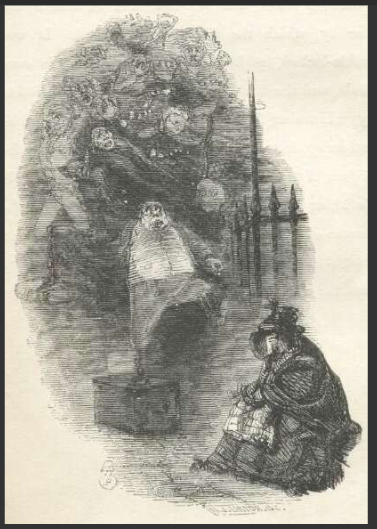
Before Marley’s departure, Scrooge gazes from his window and witnesses countless phantoms suffering in agony, tormented by the realization that they can no longer assist in the affairs of men. He observes, “The misery with them all was, clearly, that they sought to interfere, for good, in human matters, and had lost the power forever.” This powerful scene reminds us of an important truth: we must do good while we have the opportunity.
Scripture echoes this message.
Galatians 6:10 – Therefore, as we have opportunity, let us do good to all people, especially to those who belong to the family of believers.
We are encouraged not to let opportunities slip by.
Proverbs 3:27 – Do not withhold good from those to whom it is due, when it is in your power to act.
Ultimately, knowing the right thing to do carries a responsibility:
James 4:17 – If anyone, then, knows the good they ought to do and doesn’t do it, it is sin for them.
Let us be mindful, then, to act while we are able, making the most of every chance to do good.